Quantifying the operational overhead of multi-sourcing sample and how FieldworkOS automates the vendor supply chain
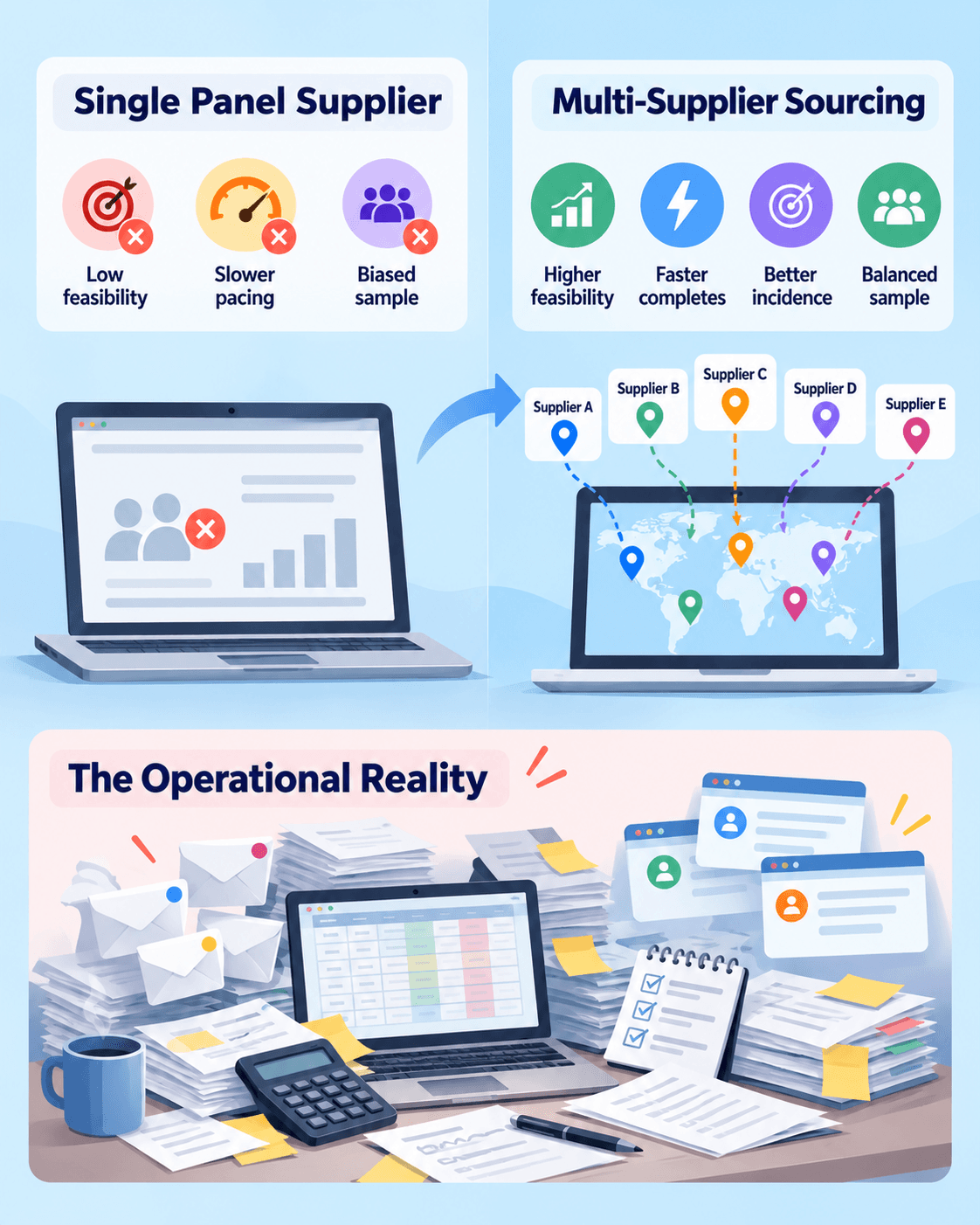
In quantitative research, the decision to move beyond a single panel provider is a strategic turning point. On paper, the choice is obvious: single suppliers hit feasibility ceilings on niche B2B targets, suffer pacing slowdowns during late field stages, and introduce demographic conditioning that degrades data quality.
Multi-sourcing online sample across three, five, or ten specialized suppliers instantly unlocks higher feasibility, faster field completes, better incidence rates, and improved sample balance. However, once a research lead signs off on a multi-vendor strategy, the operational reality hits the project management desk.
What looks like a simple strategic shift on a slide deck quickly turns into a logistical nightmare. Managing multiple sample suppliers manually introduces a massive administrative tax across every stage of the project lifecycle. Project Managers (PMs) stop acting as research strategists and become full-time logistics coordinators, spending hours copying links, parsing fragmented emails, calculating manual CPI averages, tracking quota cells in spreadsheets, and disputing invalid completes across conflicting vendor portals.
The 10 Administrative Bottlenecks
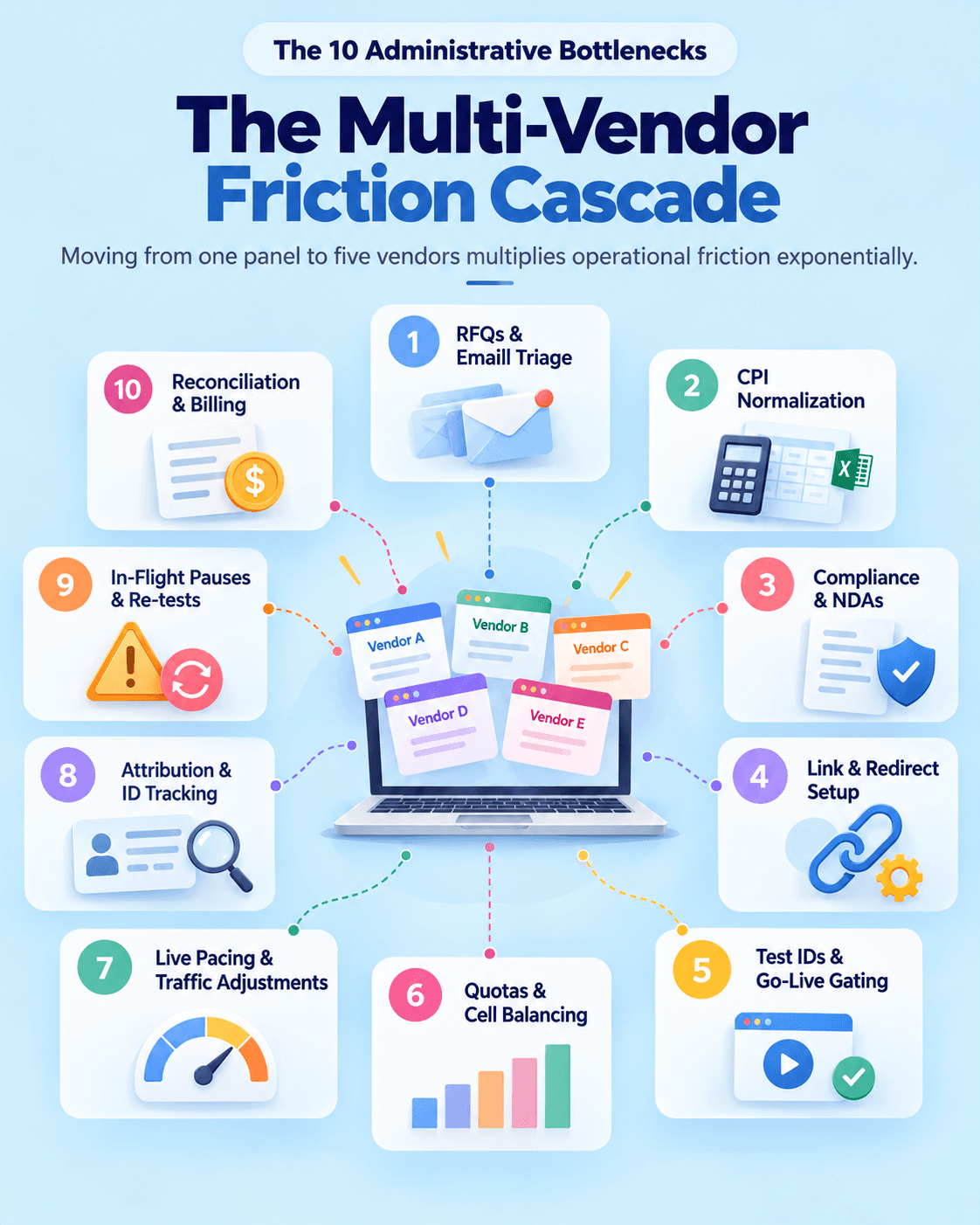
Moving from one panel to five vendors multiplies operational friction exponentially. Each step in the fieldwork lifecycle generates administrative tasks that grow larger with every supplier added to a study
THE MULTI-VENDOR FRICTION CASCADE
- RFQs & Email Triage: Dozens of open threads per study; fragmented quote formats (flat CPIs, tiered rates, or package costs).
- CPI Normalization: Manually extracting rates into master spreadsheets to calculate blended costs and feasibility per quota cell.
- Compliance & NDAs: Onboarding spot-market partners under tight deadlines introduces legal tracking and terms overhead.
- Link & Redirect Setup: Creating, appending parameters, and verifying unique redirect URLs across multiple vendor platforms
- Test IDs & Go-Live Gating: Executing manual link testing to verify parameter passing and postback functionality.
- Quotas & Cell Balancing: Siloed vendor portals lead to over-buying easy cells while hard-to-fill cells stall.
- Live Pacing & Traffic Adjustments: Constantly refreshing multiple dashboards to balance traffic allocations mid-field.
- Normalizing mismatched vendor identifier formats (UUIDs, custom tokens, numerical IDs) into clean logs.
- In-Flight Pauses & Re-tests: High communication lag during quality incidents allows invalid responses to pollute the sample pool
- Reconciliation & Billing: Spending days cross-referencing CSV entry logs and timestamp records against vendor invoices.
Quantifying the Operational Overhead
To understand why multi-supplier management breaks traditional research operations, we can look at the time spent on administrative tasks for a standard quantitative study
| Workflow Stage | Single Panel (1 Vendor) | Manual Multi-Supplier (5 Vendors) | Automated Layer (FieldworkOS) |
|---|---|---|---|
| RFQ Distribution & Intake | 10 mins | 2.5 hours | Automated |
| Bid Parsing & CPI Normalization | 10 mins | 1.5 hours | Automated |
| Link Generation & Setup | 15 mins | 2.0 hours | Automated |
| Testing & Go-Live Verification | 20 mins | 1.5 hours | Automated |
| Live Pacing & Quota Monitoring | 1.5 hours | 8.0 hours (over field cycle) | Real-Time Engine |
| Quality Isolation & Pauses | 30 mins | 3.0 hours | Real-Time Engine |
| Post-Field Reconciliation | 30 mins | 4.0 hours | Automated |
| Total Overhead Hours | ~3.5 Hours | ~22.5 Hours | < 1.0 Hour |
The Scalability Wall
When a project manager spends over 22 hours per study on administrative tasks, sample management becomes a major operational bottleneck:
- Capacity Hard Cap: A senior PM can manage a maximum of 3 to 4 multi-sourced studies concurrently before administrative tasks consume their entire week
- Margin Loss: Human errors during link setup, missed quota over-runs, and un-reconciled vendor invoices erode project margins by 8% to 15
- Turnover & Burnout: Senior insights professionals spend their days copying links and matching invoice spreadsheets instead of focusing on research design, data analysis, and client relationships
SoftSight FieldworkOS: The Workflow Layer
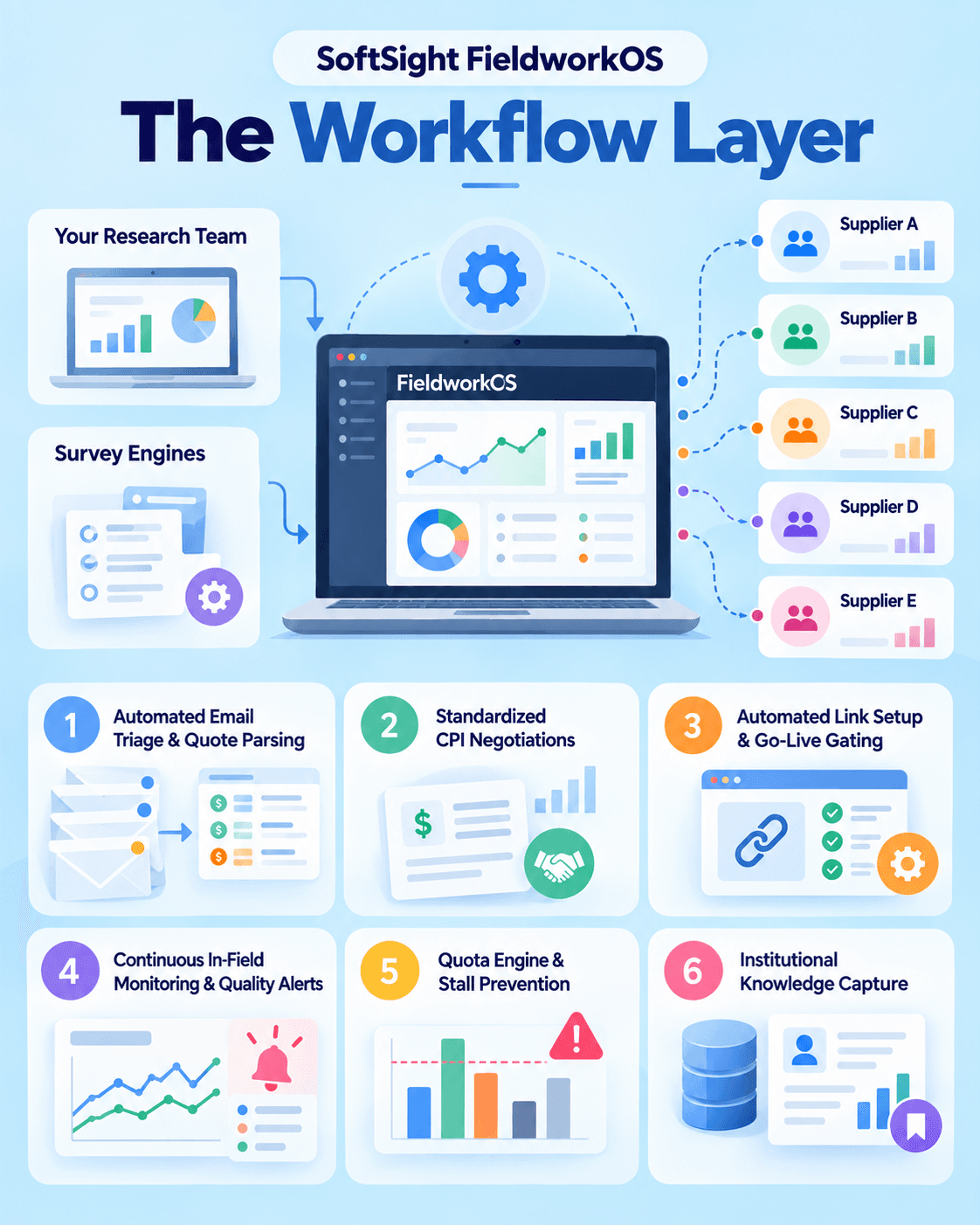
SoftSight FieldworkOS breaks the trade-off between speed, volume, and quality. Rather than acting as a broker or a reseller, FieldworkOS is an operational platform built to manage the entire supplier lifecycle. It sits between your research team, your survey engines, and your sample suppliers, reading project inboxes, negotiating CPIs, verifying launches, and monitoring field metrics in real time
Automated Email Triage & Quote Parsing
AI listener processes supplier email threads, automatically structuring CPI quotes, feasibility estimates, and thread statuses into a structured data feed. 1
Standardized CPI Negotiations
Leadership sets strategy and target CPI ranges; FieldworkOS executes negotiations across all supplier threads backed by pricing history
Automated Link Setup & Go-Live Gating
Builds links, swaps test parameters, and verifies redirects across suppliers in parallel. Go-live is gated on system proof of working links.
Continuous In-Field Monitoring & Quality Alerts
Tracks IR accuracy, drop-off rates, quality rejection rates, and fraud flags (<200ms SurveyGuard inspection), alerting PMs the moment a threshold slips.
Quota Engine & Stall Prevention
Tracks every cell across every supplier in real time, raising slow-progress alerts and automatically shutting off traffic when quotas fill.
Institutional Knowledge Capture
Enriches supplier profiles after every project with delivery reliability scores and historical benchmark data for future bidding rounds.
Model Comparison
| Dimension | Single-Panel Model | Manual Multi-Vendor | SoftSight FieldworkOS |
|---|---|---|---|
| Feasibility & Reach | Low (one pool) | High (multi-source) | High (multi-source) |
| Operational Overhead | Low (~3.5 hrs/study) | Extreme (~22.5 hrs/study) | Low (<1.0 hr/study) |
| RFQ & Quote Handling | Manual email thread | Fragmented spreadsheets | Automated AI inbox & bid structuring |
| Link & Setup Risk | Low (one link set) | High (serial copy-paste errors) | Zero (automated creation & gated verification) |
| In-Field Vigilance | Periodic manual checks | Fragmented portal refreshing | Real-time automated tracking & alert engine |
| Quota Control | Basic internal limits | Manual tracking per portal | Real-time multi-supplier quota engine |
| Fraud Protection | Vendor-dependent checks | Manual post-field removal | Real-time entry gating (<200ms) |
| Reconciliation | Simple single invoice | Complex manual crossreferencing | Automated complete logs & verified billing |