Every client asks for proof your data is clean. Most agencies have a list. Winners have evidence. This is the difference.
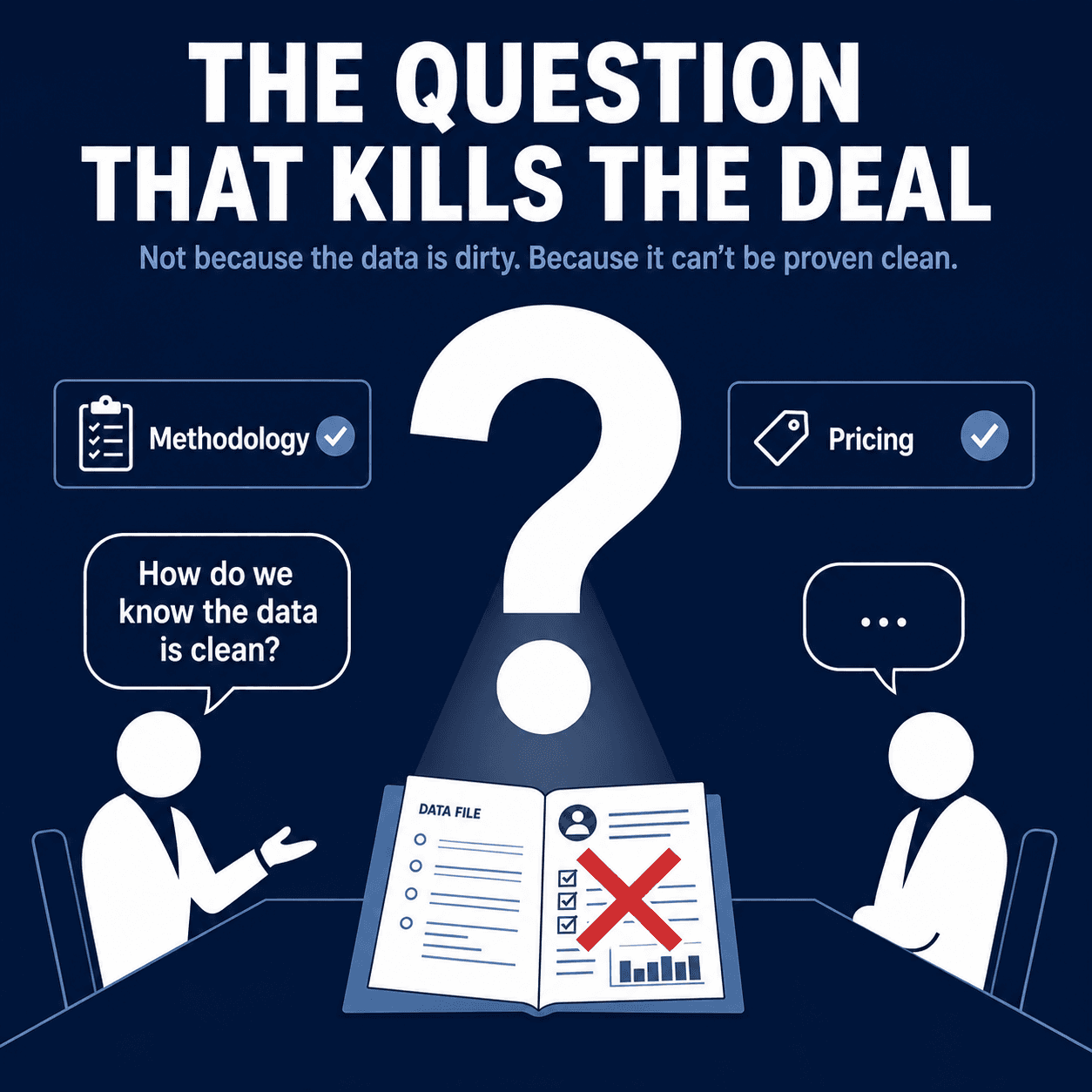
The Question That Kills the Deal It happens in the final ten minutes of the pitch. The research has been presented. The methodology is sound. The team is credible. The pricing is competitive. The client leans forward and asks the question that every agency dreads. 'How do we know the data is clean?' Not 'what quality checks do you use?' That is a process question. The client is asking for proof. Evidence. Something they can show their board. Something that survives scrutiny. Something that does not require them to take the agency's word for it. Most agencies fail at this moment. Not because their data is dirty. Because they have no way to prove that it is clean.
The Standard Answer - and Why It Fails
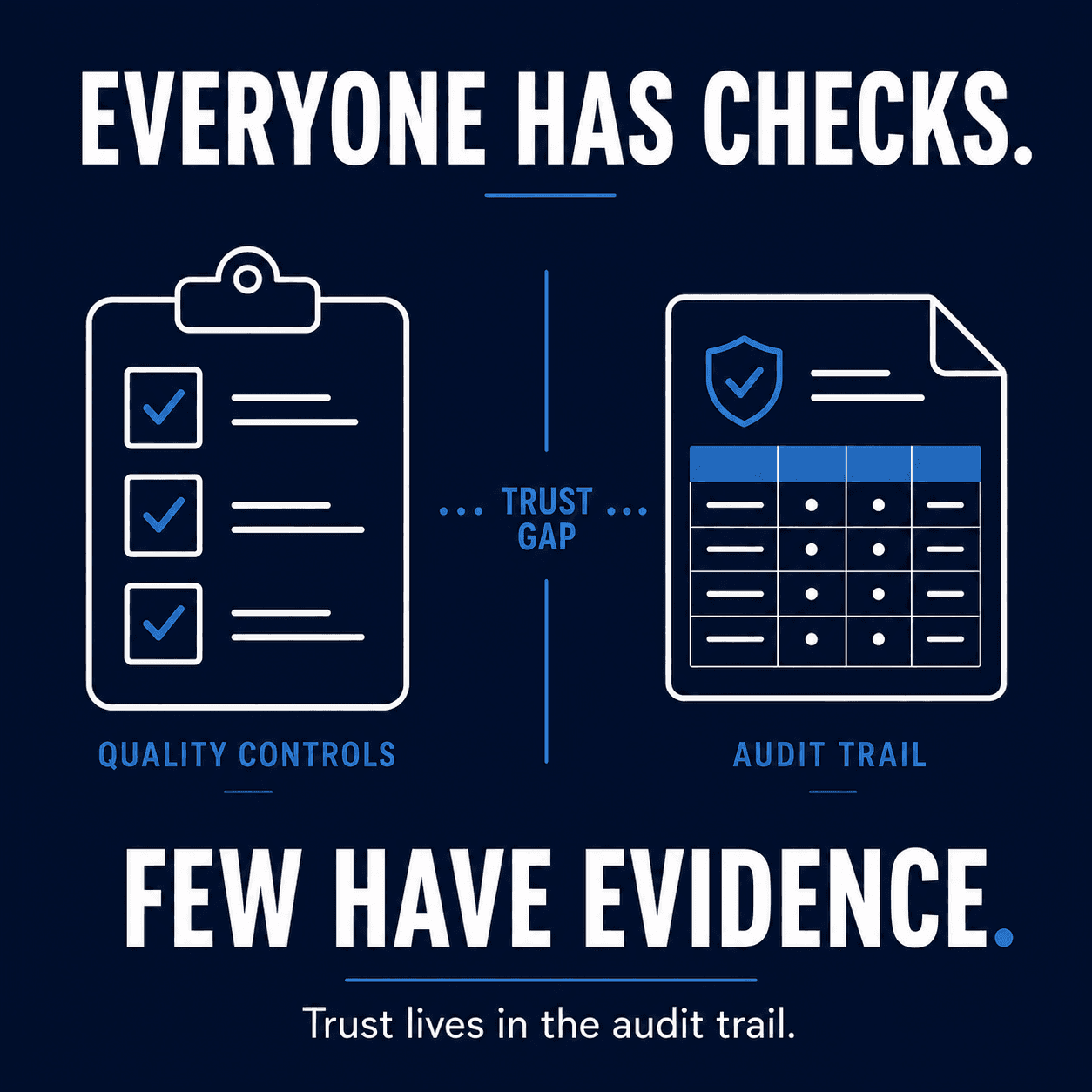
The standard response is a list. Speed traps. Attention checks. Consistency filters. Deduplication. Post-fieldwork cleaning. The client nods. The client has heard this list before. Every agency says the same thing. The list does not differentiate. It does not reassure. It describes what most agencies do, and the client already knows that what most agencies do is not always enough. The problem with the standard answer is that it describes prevention, not proof. The client is not asking what the agency does to prevent bad data. The client is asking what the agency can show to demonstrate that prevention worked. These are different questions. And the agencies that confuse them lose the deals that matter.
“"'We use rigorous quality controls' is a claim. 'Here is the complete audit trail' is evidence. The gap between them is where trust lives or dies." ”
What Most Agencies Cannot Produce
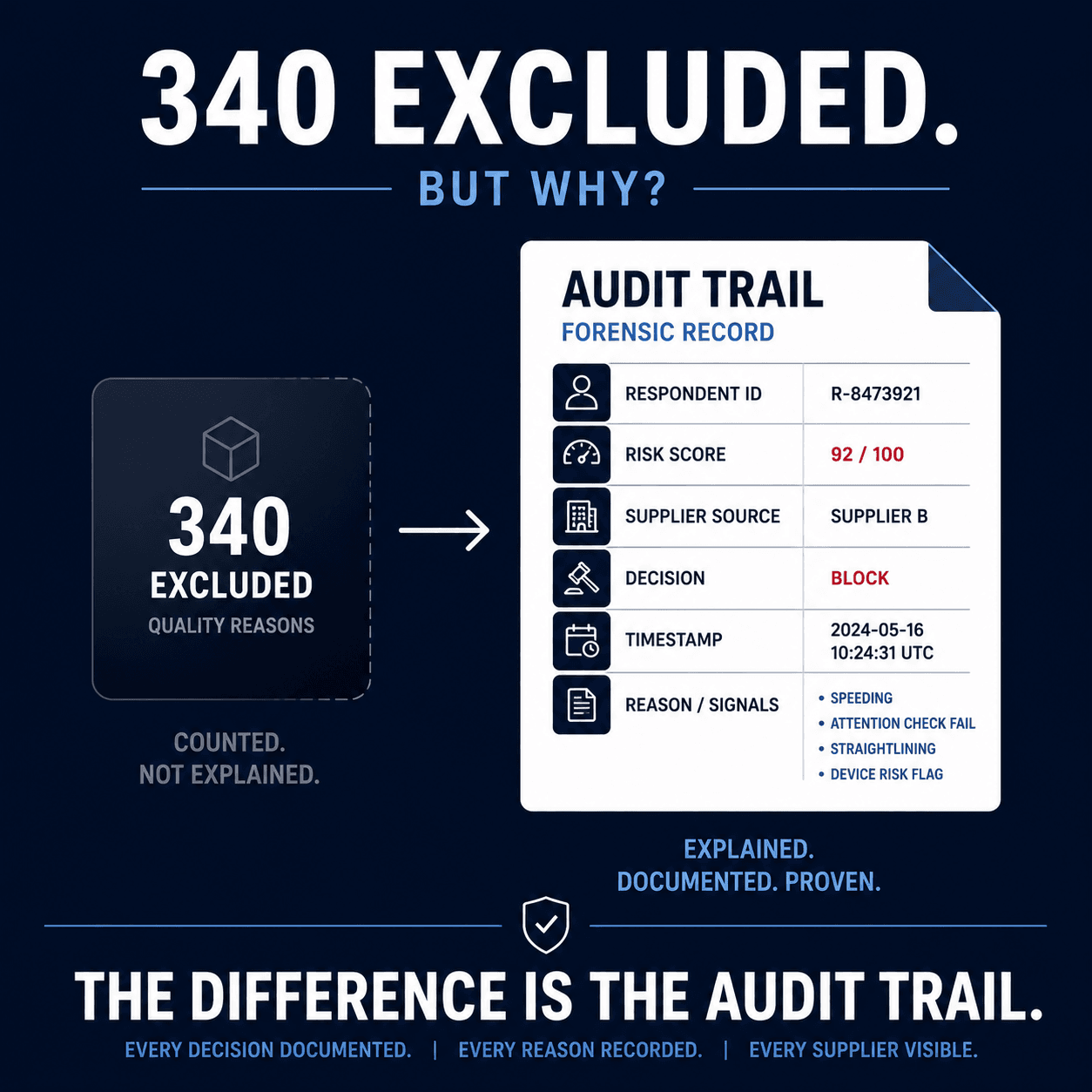
The agencies that win high-stakes pitches are those that can produce something most competitors cannot: a complete, time-stamped, respondent-level record of every quality decision made during fieldwork.
This is not a methodology note. It is not a summary of exclusions. It is a forensic document that shows, for every respondent who attempted the survey, what signals were analyzed, what risk score was assigned, what verdict was rendered, and what action was taken. Allow. Flag. Challenge. Block. Ghost. Each decision documented. Each reason recorded. Each supplier's contribution visible.
Most agencies cannot produce this because their quality processes do not generate it. The speed trap catches the speeder. The attention check catches the inattentive. The consistency filter catches the inconsistent. But the catching happens invisibly. The exclusions are counted. The methodology note says 'n=340 excluded for quality reasons' and stops there. There is no record of who those 340 were. No record of which suppliers they came from. No record of what specific signals triggered their exclusion. No record of whether the fraud was amateur or professional, isolated or systematic.
The Three Clients Who Ask
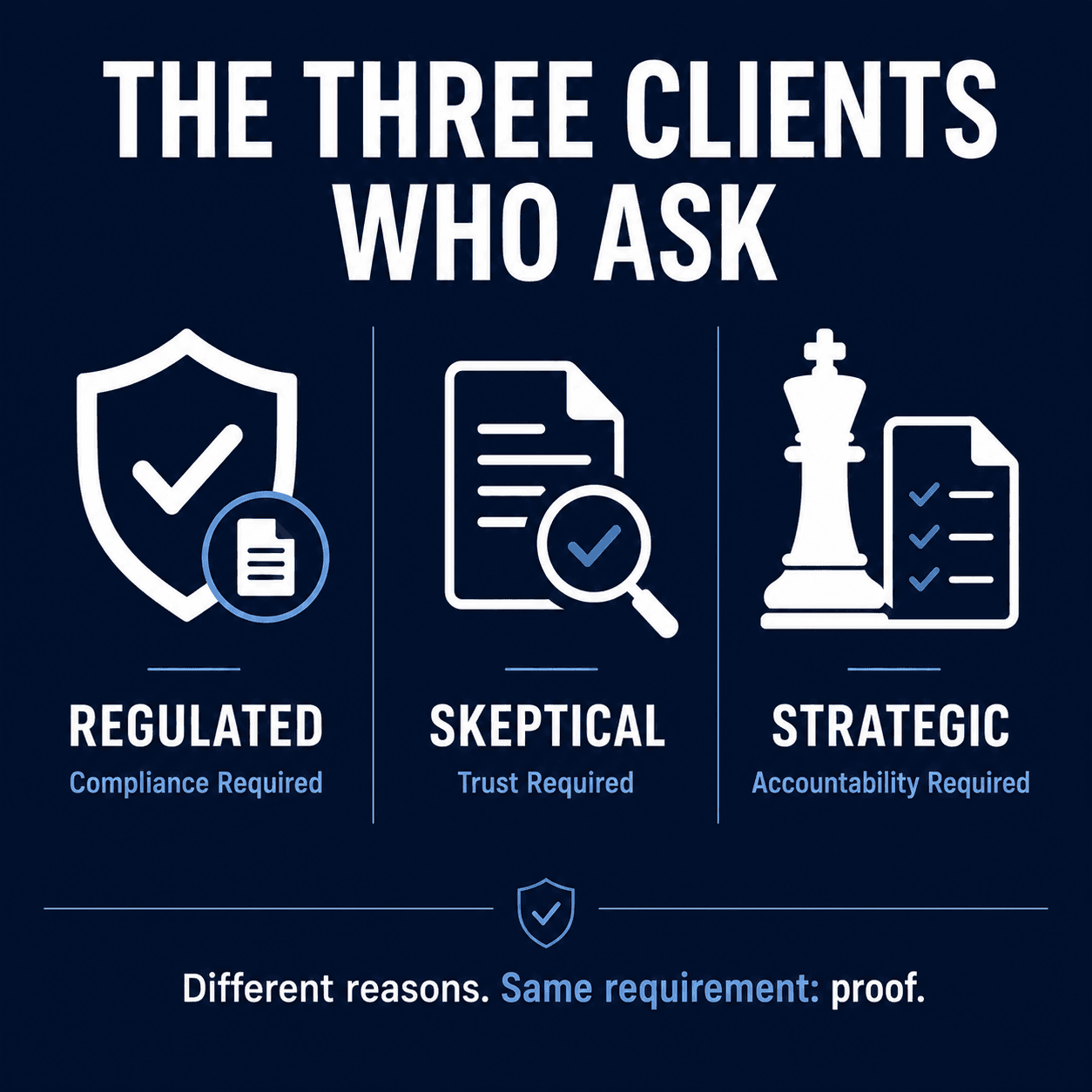
- The regulated client. Pharmaceutical, financial services, healthcare. These clients operate under compliance frameworks that require documented quality controls for any data used in regulatory submissions, clinical decisions, or public policy. An agency that cannot produce an audit trail is not just commercially disadvantaged. It is operationally excluded from a significant and growing market segment.
- The skeptical client. A client who has experienced data quality issues in the past, either with this agency or with another. They are not asking for reassurance. They are asking for insurance. They want to know that if something goes wrong, the agency can show exactly what happened, when it happened, and what was done about it. They are buying confidence, not methodology.
- The skeptical client. A client who has experienced data quality issues in the past, either with this agency or with another. They are not asking for reassurance. They are asking for insurance. They want to know that if something goes wrong, the agency can show exactly what happened, when it happened, and what was done about it. They are buying confidence, not methodology.
What Proof Looks Like
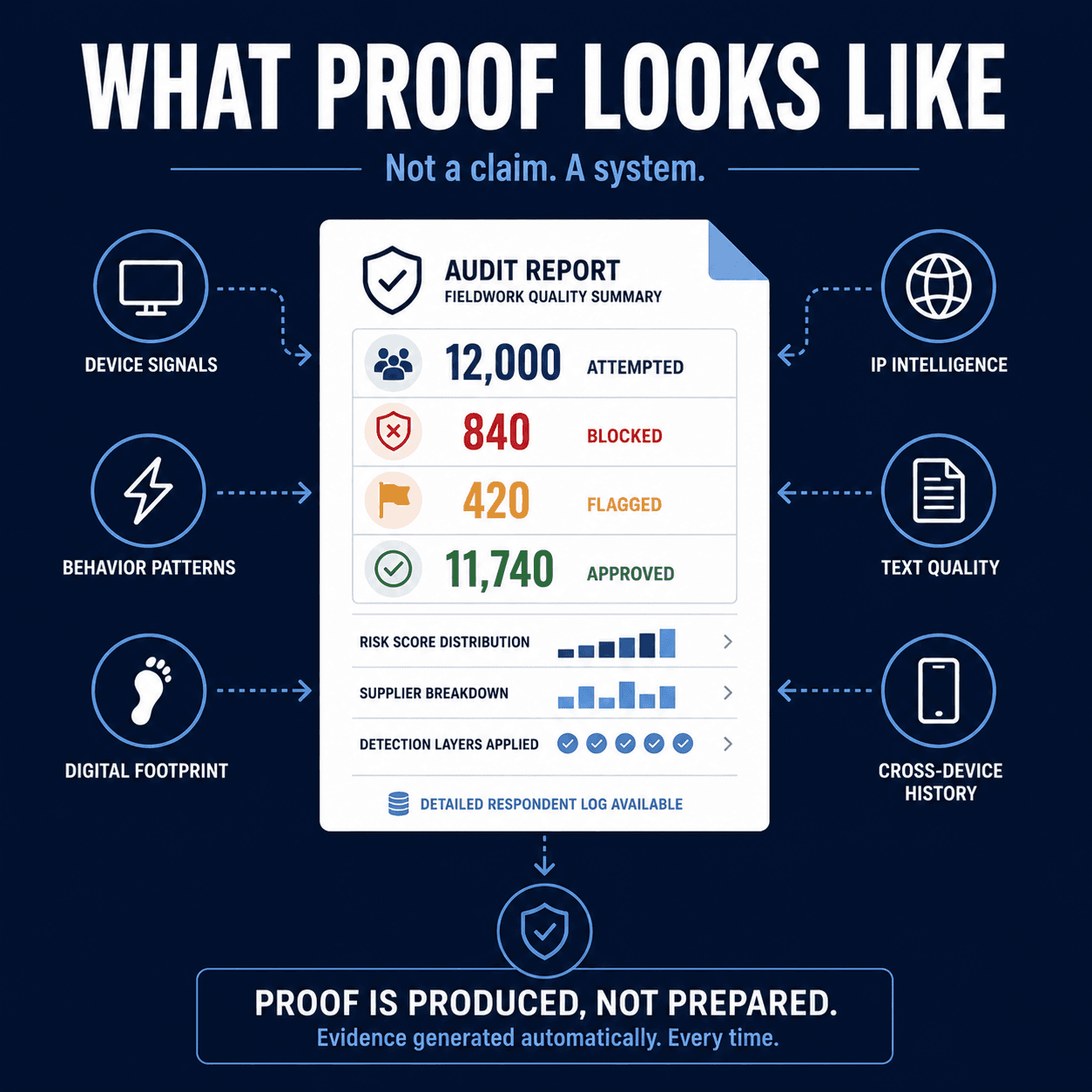
Proof is not a claim. It is a system. A system that generates evidence as a byproduct of normal operations, not as an afterthought when a client asks for it.
The system evaluates every respondent in real time, before they reach the first question. It analyzes hardware signals, behavioral patterns, IP intelligence, text quality, digital footprints, and cross-device history. It combines these signals into a unified risk score. It renders a verdict. It logs the verdict with a timestamp. It associates the verdict with the supplier who sent the respondent. It stores the record in a format that can be exported, searched, and reviewed.
The result is not just cleaner data. It is data that can be defended.
When the client asks 'how do we know the data is clean?' the agency does not recite a list of quality checks. The agency produces a report. Twelve thousand respondents attempted the survey. Eight hundred and forty were blocked at entry. Four hundred and twenty were flagged for review. Eleven thousand seven hundred and forty proceeded. Here is the distribution of risk scores. Here is the breakdown by supplier. Here is the list of detection layers applied. Here is the detailed log if you would like to review it
This is not a pitch. It is a demonstration. And demonstrations convert where claims do not.
The Margin of Trust
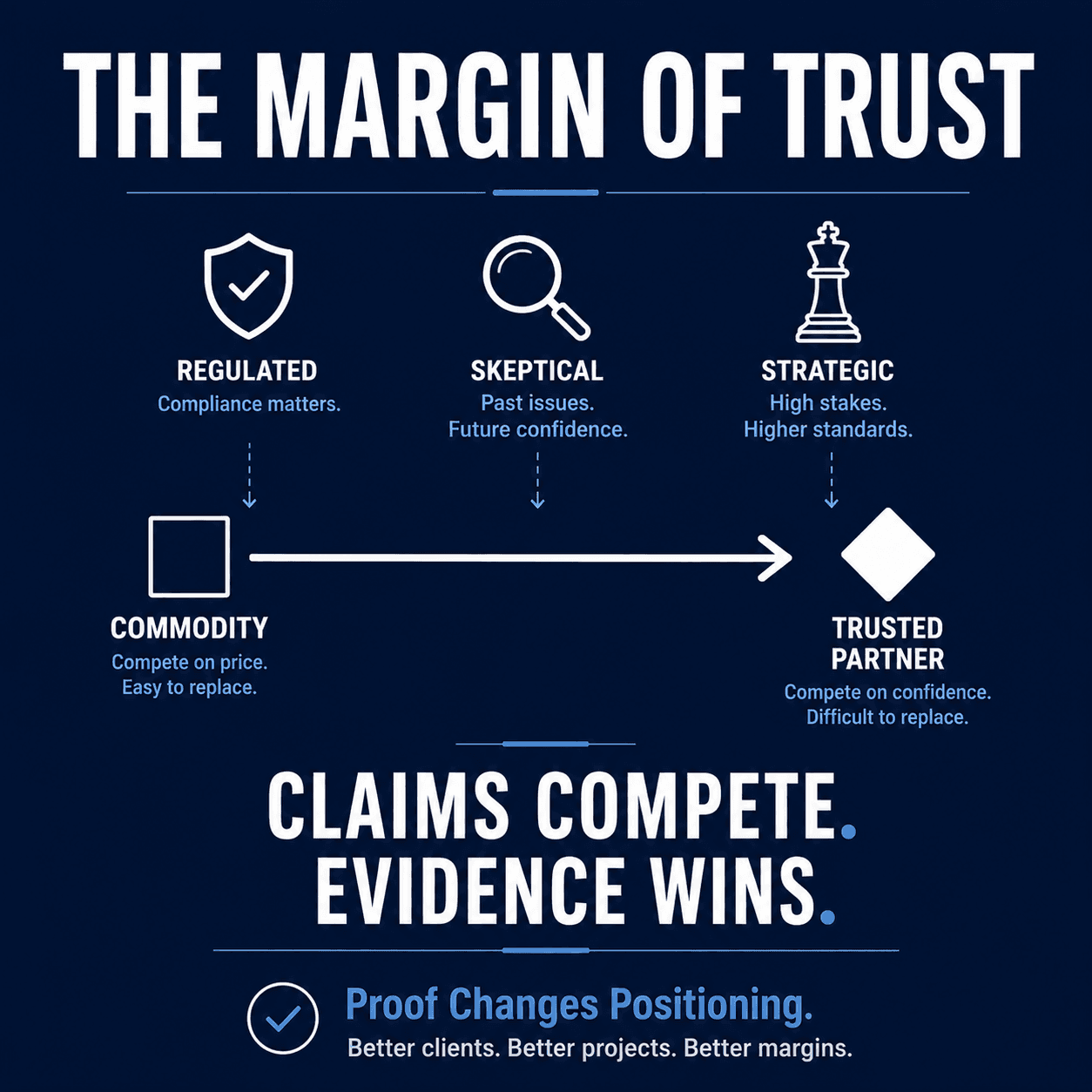
The agencies that can demonstrate data quality are not just winning pitches. They are winning better pitches. The regulated clients who pay premium rates. The strategic clients who commission large-scale studies. The skeptical clients who become loyal after their first experience with provable quality.
These clients do not negotiate on price alone. They negotiate on confidence. They are willing to pay more for an agency that can substantiate its quality claims than for an agency that can only describe them. The difference is not marginal. It is structural. It changes the agency's position in the market from a commodity provider to a trusted partner.
The investment required to build this capability is modest compared to the revenue it unlocks. The technology exists. The integration is straightforward. The only barrier is the decision to stop accepting that 'we use rigorous quality controls' is an adequate answer to a question that increasingly demands proof
“"The agencies that survive the next decade will not be the ones with the best claims. They will be the ones with the best evidence."”