How modern insights operations leverage multi-supplier open networks to achieve feasibility, speed, and diversity without operational friction.
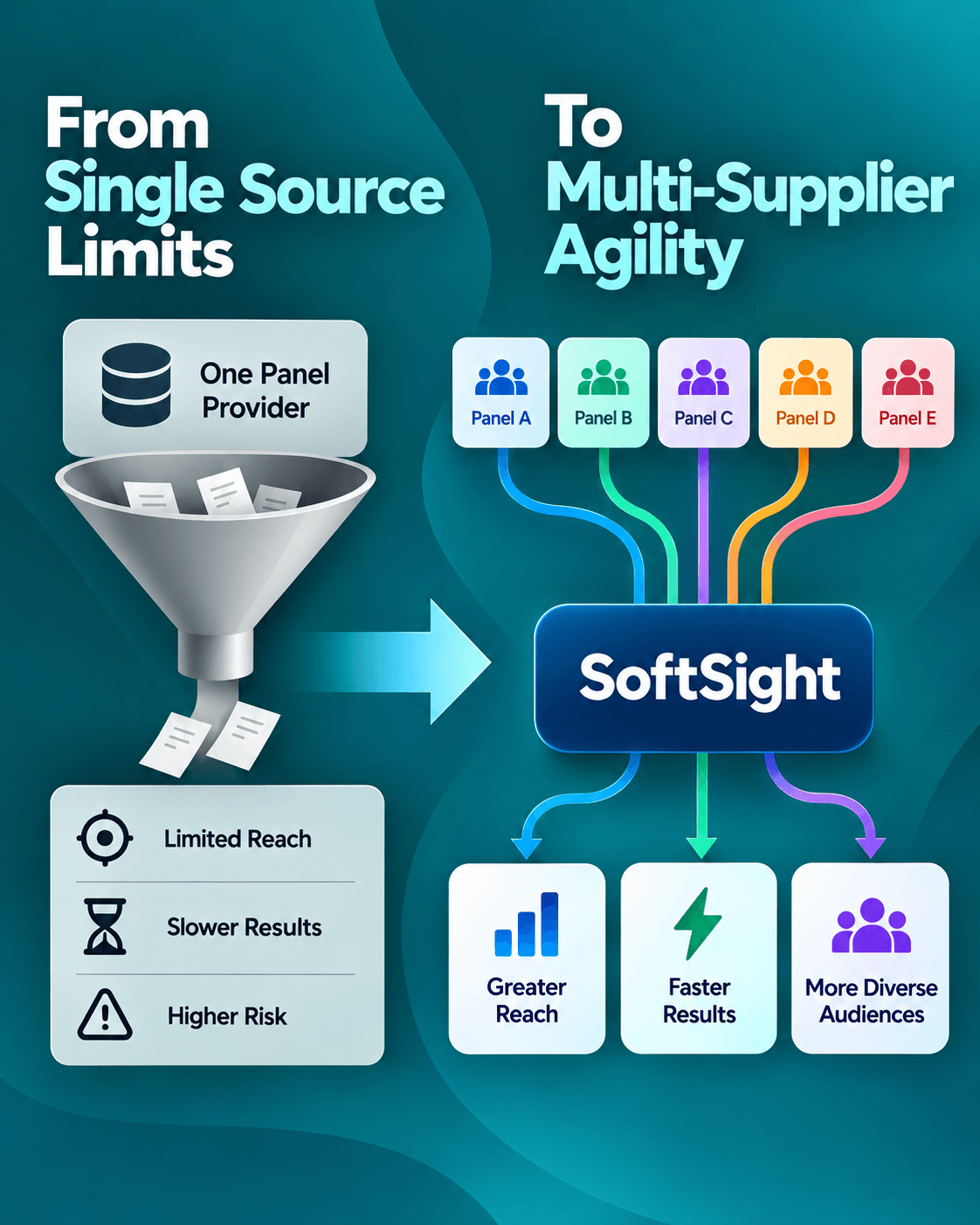
For decades, the standard playbook for quantitative data collection relied on a comfortable default: sign an exclusive contract with a single mega-panel provider, send every survey link to that single pipe, and wait for results.
That single-source approach is breaking down. As target audiences become more niche, decision cycles shorten, and data-integrity challenges reach an all-time high, relying on one sample provider creates severe structural limitations in reach, feasibility, speed, and audience diversity.
Leading market research agencies, corporate insights groups, and strategy consultancies are migrating to multi-supplier fieldwork models. However, diversifying supply chains historically introduced a massive operational tax a chaos of fragmented emails, incompatible bid spreadsheets, manual link swaps, and post-fieldwork reconciliation nightmares. Modern insights operations can achieve multi-source agility without taking on manual friction by leveraging operating layers like the SoftSight Open Network.
The Hidden Costs of the Single-Panel Model
To understand why research teams are shifting, we must look at where the traditional single-panel approach falls short under modern operational demands.
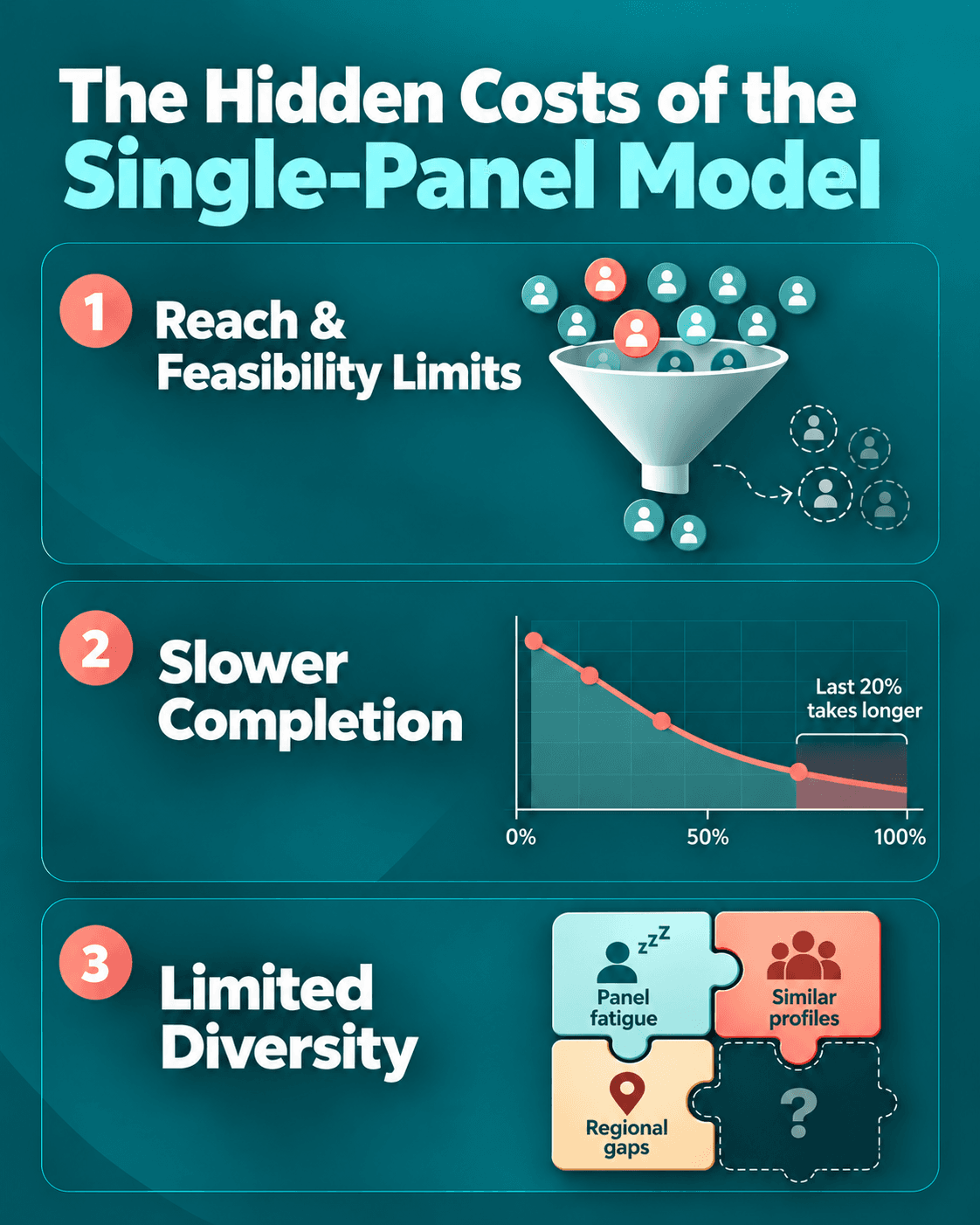
Reach & Feasibility Ceiling
No single panel owns the entire internet. While a general population (GenPop) sample in a major market might seem easy to fill through one provider, the moment a study requires niche criteria— such as enterprise IT decision-makers, rare disease patients, rural small-business owners, or specific B2B personas single panels hit an immediate feasibility ceiling.
When a single provider over-promises on a complex quota, field managers face mid-fieldwork stalling. The study sits at 60% completion, deadlines loom, and researchers are forced to scramble for secondary suppliers mid-flight, often paying premium spot-rates to bridge the gap.
Speed to Complete and Pacing Decay
A single supplier’s invitation yield follows a natural curve of diminishing returns: initial waves net rapid completes from active, highly responsive panelists, but as high-response segments exhaust, field velocity slows to a crawl. Reaching the final 20% of quotas requires longer field times, repeated reminders, or loosening screening criteria compromising project timelines and sample integrity.
Audience Diversity & Panel Conditioning
Panelists within a single proprietary network are subjected to similar onboarding paths, incentive structures, and survey rhythms. Over time, panel fatigue and conditioning set in:
- Professional Respondents: Heavy survey takers learn how to bypass screeners to earn rewards.
- Demographic & Behavioral Homogeneity: Panels sourced through specific affiliate channels attract shared demographic traits or digital habits, missing broader cross-sections of the actual consumer population.
- Geographic & Regional Gaps: A provider strong in urban centers may lack depth in suburban or tier-2/tier-3 regions, skewing localized insights.
Multi-Supplier Fieldwork: The Operational Paradox
If diversifying sample sources solves issues with reach, speed, and sample balance, why haven't all research teams moved away from single panels? The answer lies in operational friction. Moving from one panel to five traditional vendors historically multiplied administrative overhead exponentially.
THE FIVE ADMINISTRATIVE BOTTLENECKS
- Intake & Bid Reconciliation: Manually sending RFQs, waiting for email replies, and attempting to normalize disparate quote formats into a master tracking sheet.
- Setup Overhead: Generating, testing, and routing unique redirect links (completes, terminates, over-quotas) across multiple vendor portals.
- Live Traffic Balancing: Checking individual dashboards to see which partner is pacing ahead, which is stalling, and manually adjusting allocations mid-field.
- Attribution & Quality Disputes: Determining which vendor brought in which fraudulent or low-quality respondent.
- Reconciliation & Billing: Spending days reconciling final complete counts, screenouts, and partials against multiple conflicting vendor invoices.
SoftSight Open Network: Operating Layer for Sample
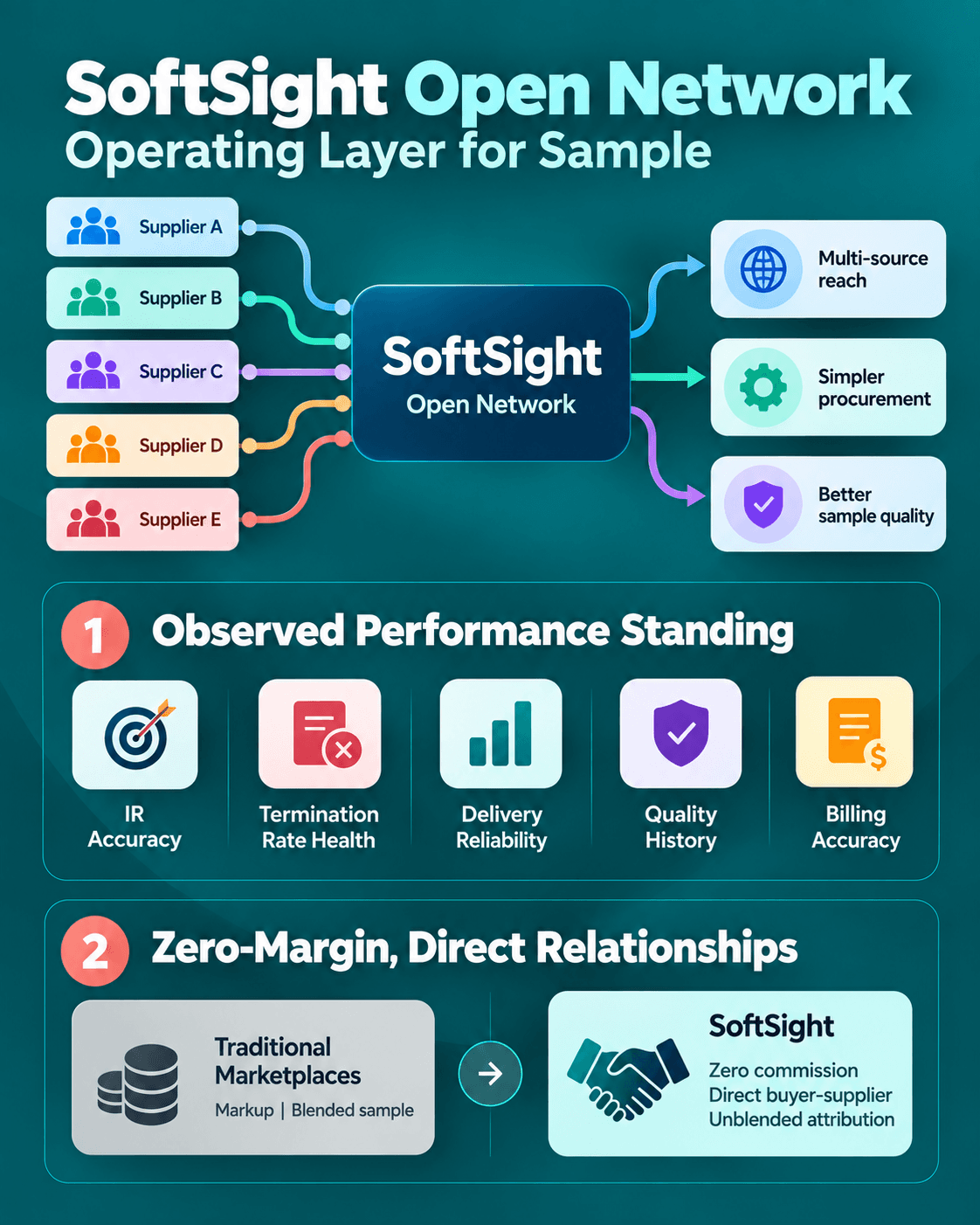
SoftSight addresses this challenge by serving as an operational software layer for online sample procurement and fieldwork execution. Rather than acting as a broker or a re-seller, SoftSight connects sample intelligence, procurement operations, and respondent quality into a unified framework
At the center of this ecosystem is the SoftSight Open Network a directory and intelligence layer of sample suppliers designed to give teams instant, multi-source reach without administrative friction.
Observed Performance Standing (Not Marketing Decks)
In traditional procurement, evaluating a sample vendor relies on capabilities decks, self-reported panel sizes, and sales claims. The SoftSight Open Network changes this by building supplier standings directly from observed fieldwork performance across actual studies. Suppliers are evaluated on concrete metrics:
- Incidence Rate (IR) Accuracy: Realized IR compared against quoted IR.
- Termination Rate Health: Clean routing without excessive drop-offs.
- Delivery Reliability: Percentage of committed volume delivered on time.
- Quality & Rejection History: Real-time data integrity flags per thousand entrants.
- Billing & Quoting Accuracy: Matching signed schedules without unexpected price adjustments.
Zero-Margin, Direct Relationships
Traditional sample marketplaces function as aggregators—they mark up cost-per-complete (CPI) prices, hide sample source attribution, and blend respondents into an anonymous pool. SoftSight operates with zero transaction commissions, direct buyer-supplier relationships, and unblended respondent attribution.
End-to-End Fieldwork Architecture
Define Audience & Scope
Specify target demographics, incidence rate, LOI, quotas, timeline, and budget.
Match & Distribute RFQs
Open Network identifies optimal suppliers based on observed performance data. FieldworkOS sends unified RFQs.
AI Quote Parsing & CPI Negotiation
LLM engine extracts CPI, feasibility, and turnaround into one dashboard. Counter-offers are automated within set bounds.
Link Verification & Go-Live Gating
Fieldwork launches only after system verification of redirects and soft-launch metrics.
Live Tracking & SurveyGuard Protection
Monitor pacing across all suppliers from one screen while SurveyGuard inspects entrants (<16ms) across 15 detection layers.
Instant Reconciliation
Close the study with auditable complete counts, verified quality verdicts, and auto-generated billing schedules.
Model Comparison
| Dimension | Single-Panel Model | Legacy Aggregators | SoftSight Open Network |
|---|---|---|---|
| Reach & Scope | Limited to proprietary bounds | Broad, but masked in broker pools | Vetted global niche/B2B/B2C suppliers |
| Pricing & Margin | Fixed rate deck; high markup | Unknown broker margin on CPI | Direct pricing; 0% transaction commission |
| Respondent Quality | Internal checks; panel fatigue | Blended sources; hard to isolate bad traffic | 100% attributed respondents + SurveyGuard protection |
| Supplier Vetting | Capabilities decks | Opaque tiering | Observed fieldwork performance metrics |
| Operational Overhead | Low friction, high feasibility risk | High manual spreadsheet/link overhead | Full process automation (AI quotes, single dashboard) |