An In-depth Industry Analysis Blending Macro Benchmarks with Advanced Behavioral Telemetry Diagnostics
Executive Summary: The Market Research Industry's Open Secret
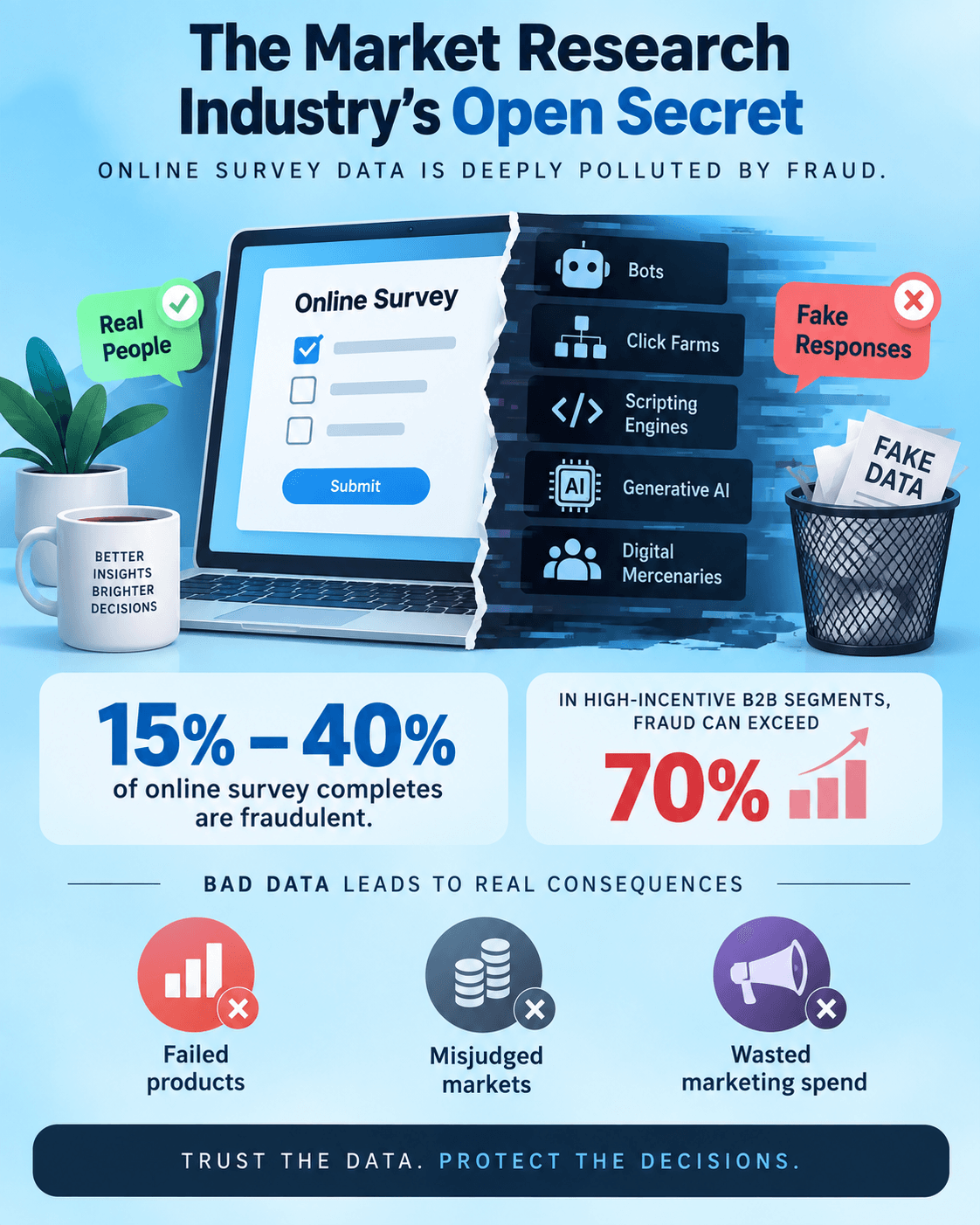
For the past two decades, the global market research apparatus has migrated silently and aggressively toward digital sample acquisition. The convenience of online survey panels has made them the default backbone for multi- billion dollar strategic realignments, venture capital due diligence, corporate positioning studies, and academic theories. Yet, beneath the clean spreadsheets and polished boardroom charts lies an open, structural secret: online survey data is deeply polluted by fraud. In a hyper-connected global internet landscape, corporate researchers are routinely budgeting millions of dollars to acquire insights not from verified target demographics, but from automated bot networks, distributed click farms, programmatic scripting engines, and low-cost digital mercenaries using Generative AI.
Recent multi-panel benchmarks indicate that between 15% and 40% of all completed online quantitative surveys are fraudulent. In highly technical, specialized B2B segments or panels offering substantial economic incentives (such as medical physicians, IT decision-makers, or C-suite executives), fraud vectors routinely skyrocket, occasionally compromising past 70% of total sample completes. When bad data infiltrates analytical pipelines, the collateral damage is immense. Organizations build product pipelines destined to fail, misjudge market caps, and launch advertising campaigns tailored to the algorithmic patterns of server scripts rather than genuine consumer intent.
1. The Macro Scale: Mapping Global Survey Corruption
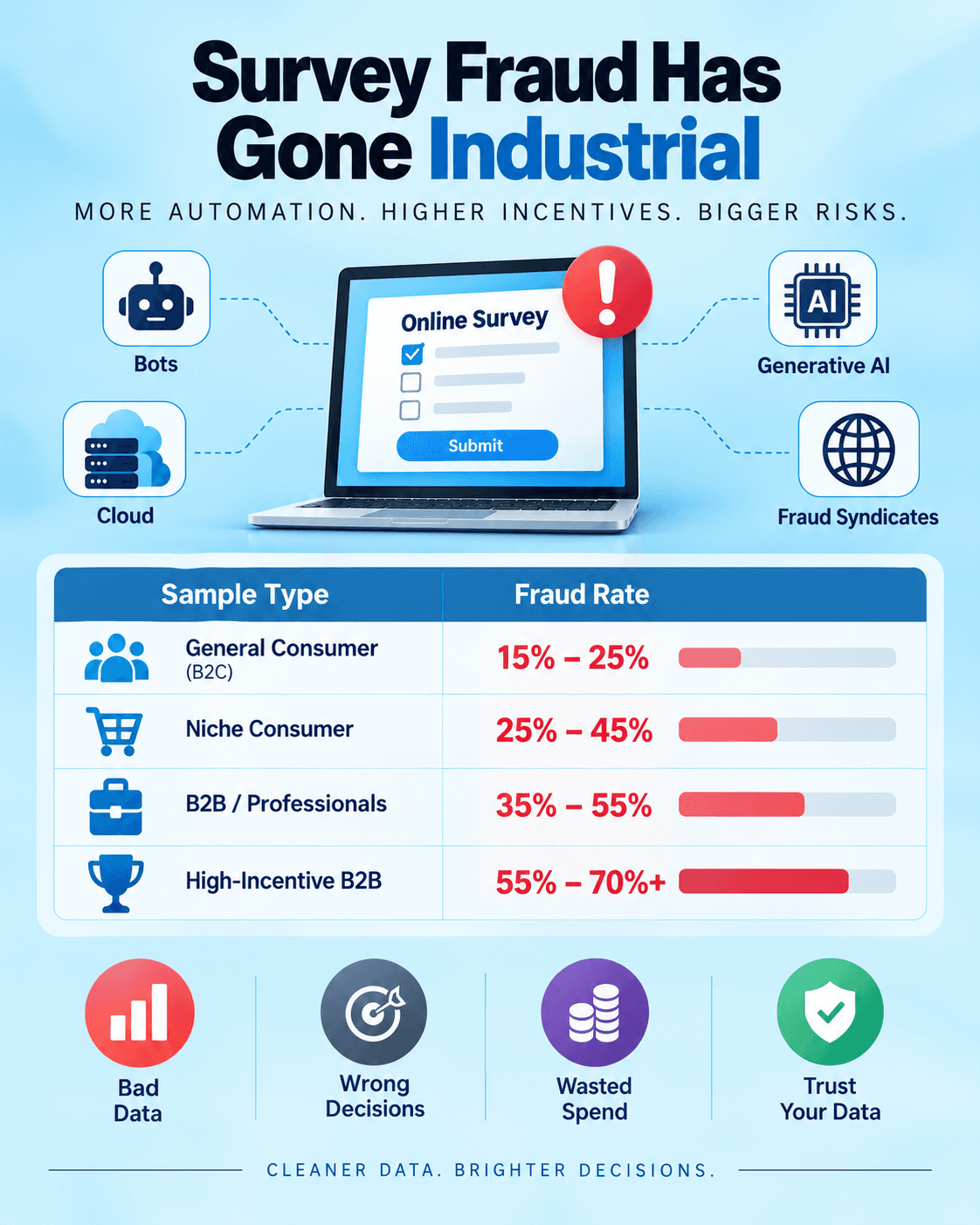
Survey fraud is no longer an isolated nuisance composed of a few college students rushing through forms for gift cards. It has transformed into an industrial-scale, programmatic enterprise operating across international boundaries. Modern fraud syndicates use cloud architecture, automated API scrapers, and localized pools of human workers organized via digital message boards to exploit the commercial incentives offered by the insights economy. The data paints an increasingly stark picture of this threat matrix.
Statistical aggregation of industry-wide validation passes shows a dramatic surge in fraudulent attempts over the last 36 months. This trend correlates directly with two macroeconomic catalysts: the widespread availability of low- cost cloud infrastructure and the consumerization of large language models (LLMs). Below, we outline standard market benchmarks for sample corruption categorized by target complexity and sample source:
| Sample Category & Target Audience | Estimated Baseline Fraud Rate | Primary Dominant Threat Vector |
|---|---|---|
| General Consumer (B2C) - Low Incentive ($1-$3) | 15% – 25% | Automated bot scripts, server-side headless browsers, macro click recorders. |
| Niche Consumer (e.g., EV Owners, Rare Disease) | 25% – 45% | Residential proxy spoofing, profile farming, manual deceptive screening. |
| Standard B2B / Professionals (IT, HR Managers) | 35% – 55% | LinkedIn identity scraping, corporate domain bypass, outsourced human panels. |
| Specialized High-Incentive B2B (MDs, C-Suite, Exits) | 55% – 70%+ | Generative AI open-end generation, multi-device fingerprint spoofing, API interception. |
2. The Three Pillars of Survey Deception
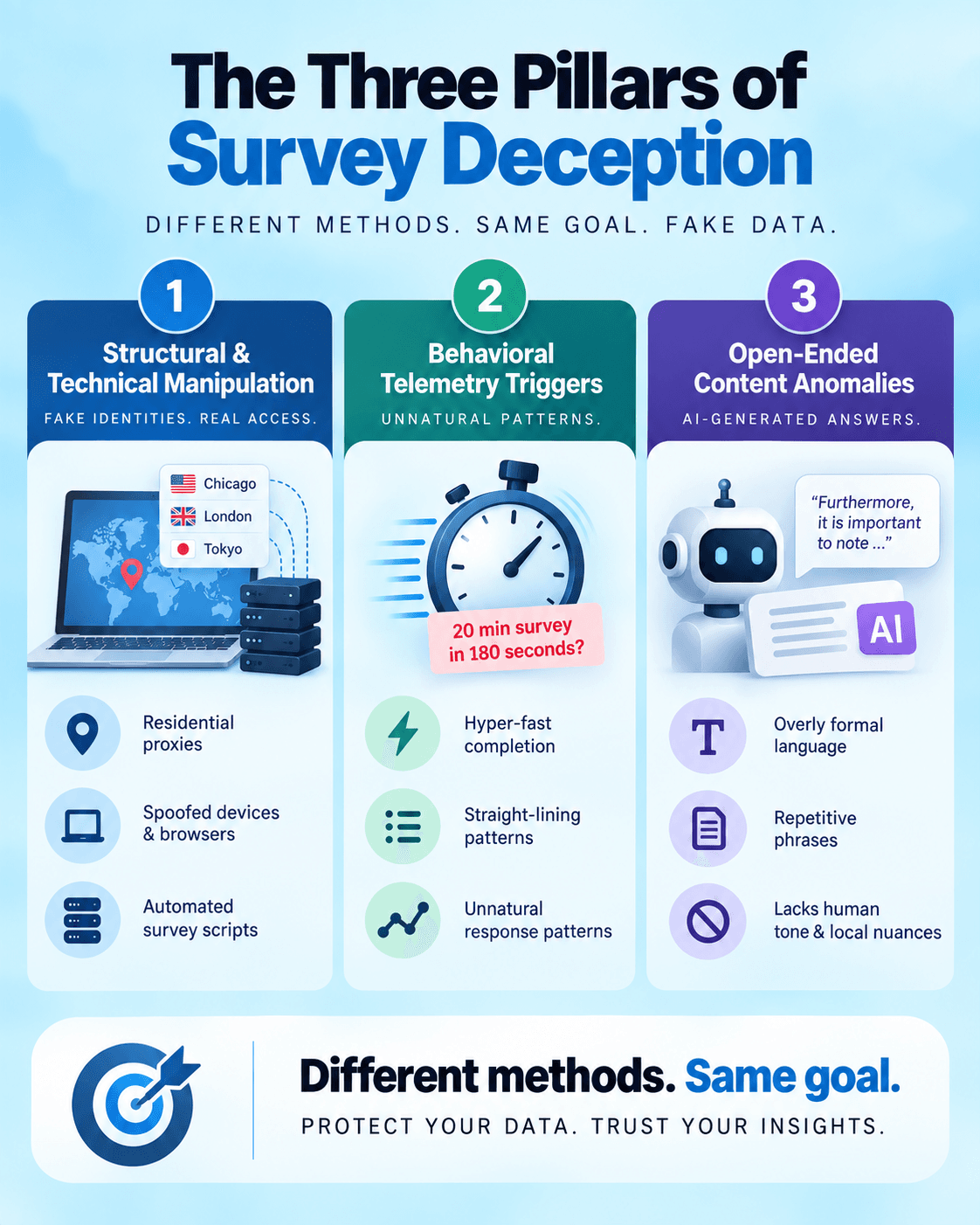
To effectively counteract the systemic rot in research datasets, researchers must first deconstruct the mechanics of fraud. Modern survey disruption manifests through three core pillars: Structural Technical Manipulation, Behavioral Telemetry Triggers, and Open-Ended Content Anomalies. Each represents a distinct tier of sophistication requiring localized methodologies to detect and eliminate.
Pillar A: Structural & Technical Manipulation
The foundational layer of data fraud is infrastructure spoofing. Highly organized survey networks bypass traditional geographic and demographic constraints using advanced networking suites. The most prevalent technique involves the deployment of residential proxies. Unlike cheap data center IPs, which are easily blacklisted by basic firewall rules, residential proxies route fraudulent traffic through legitimate home routers and local broadband networks worldwide. A user sitting in a click farm in Dhaka or St. Petersburg can appear to a security system as a consumer accessing Comcast in Chicago or British Telecom in London.
Concurrently, threat actors leverage advanced software stacks to manipulate system configurations. By altering browser attributes, device configurations, and hardware parameters, they generate entirely unique machine signatures. This circumvents simple cookie tracking and basic local storage validation. Advanced entities utilize headless browser frameworks such as Puppeteer or Playwright to run hundreds of survey instances in parallel, dynamically rotating screen resolutions, system fonts, canvas rendering hashes, and WebGL signatures to create an illusion of organic, varied human participant devices.
Pillar B: Behavioral Telemetry Triggers
The second pillar of fraud resides within the interaction profile of the participant. Fraudulent agents, specifically those optimized for high-volume throughput, display clear behavioral deviation when compared to an authentic human respondent. The most obvious indicator is hyper-speeding. A human being processing a dense matrix table question requires a finite quantum of cognitive processing time to scan the prompts, interpret the scale, and direct the cursor to make an intentional selection. Programmatic scripts or hyper-optimized human fraudsters execute these tasks in milliseconds, completing complex 20-minute instruments in under 180 seconds.
Furthermore, behavioral analysis uncovers structural shortcuts like straight-lining. This occurs when a script or disengaged respondent clicks down a single uniform column (e.g., choosing 'Neutral' or option '3' on every single scale item across twenty distinct rows). More sophisticated variations incorporate artificial randomness, injecting sporadic deviations (such as a pattern of 3,3,3,4,3,3,3) to intentionally evade basic rule-based data cleaning scripts while maintaining an unnaturally low variance across the broader survey population.
Pillar C: Open-Ended Content Anomalies
The third pillar has undergone a dramatic transformation due to the rapid consumerization of generative artificial intelligence. Historically, open-ended questions were highly effective backstops against automated bots. If a bot encountered a prompt asking: 'Please describe in detail your primary reason for choosing your current cloud computing provider,' it would either leave it blank, provide unintelligible gibberish, or copy-paste text directly from the prompt or a random website.
Today, survey bots are programmatically integrated with generative language model APIs. When confronted with an open-ended question, the script routes the text to an LLM instance with instructions to generate a realistic, contextually accurate response within a specified word length. These answers are syntactically flawless and grammatically correct. However, they exhibit distinct macro-level signals: they are overly formal, rely heavily on repetitive, predictable transitional phrases (e.g., 'Furthermore,' 'It is important to note,' 'In summary'), and omit the highly localized colloquialisms, spelling errors, and unstructured syntax that characterize genuine human communication. In worst-case scenarios of poor bot scripting, they accidentally output standard system guards, such as: 'As an AI model developed by OpenAI, I do not possess a corporate budget, but my theoretical preference for a cloud provider would be based on scalability...'
3. Why Traditional Defenses are Failing
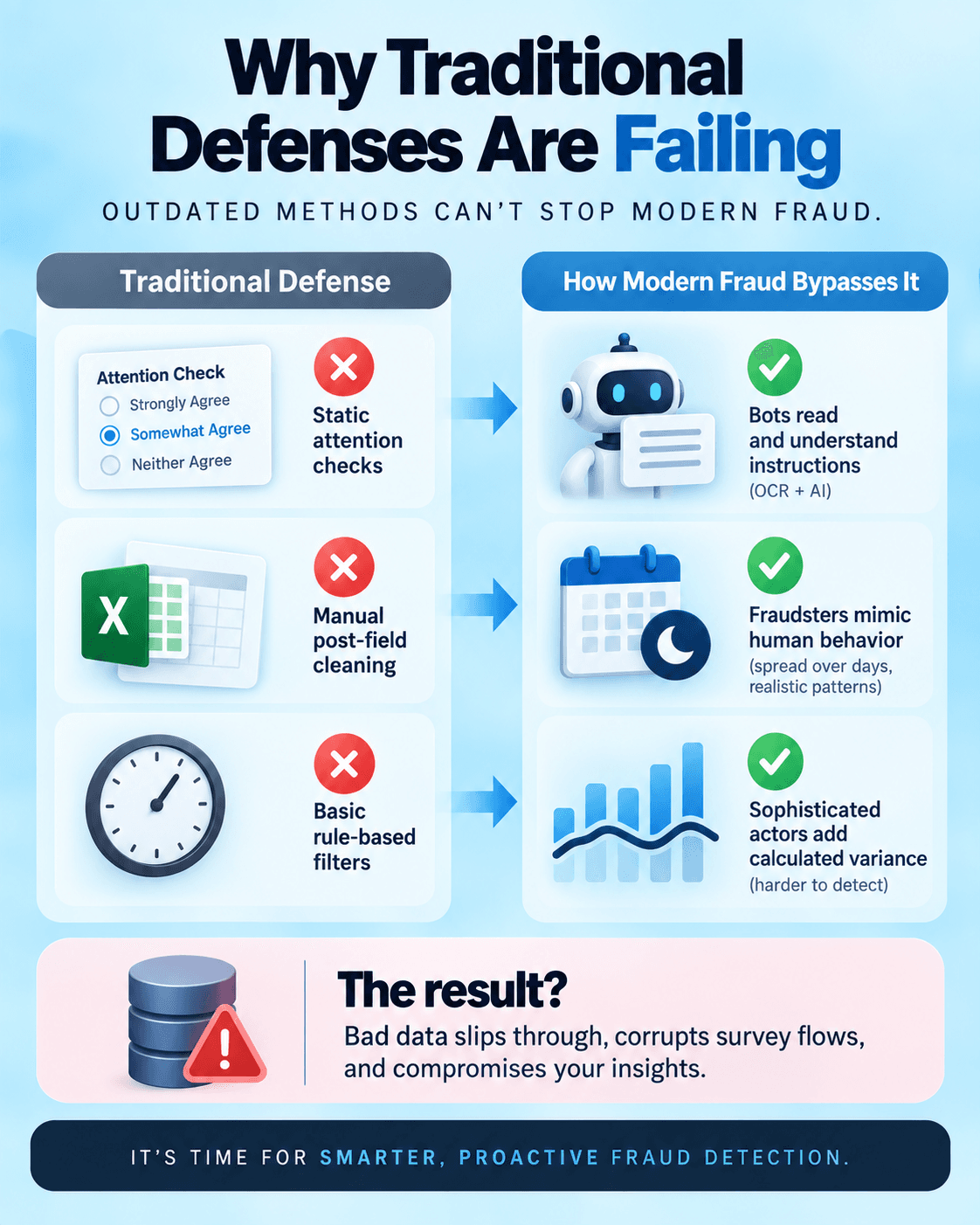
The continuous survival of these fraud networks is largely attributable to the obsolete nature of defensive mechanisms utilized by mainstream market research agencies. The standard operating procedure for mid-tier sample cleaning relies on retroactive, static attention checks. These consist of explicit instructions buried inside long blocks of text, such as: 'For quality purposes, please select option 'Somewhat Agree' for this statement.'
While these checks successfully eliminated simple, primitive bots of the mid-2010s, they are entirely ineffective against contemporary threats. Modern automated survey scrapers use optical character recognition (OCR) and semantic processing engines to read and decode instructions. They flag these exact linguistic patterns instantly, select the requested option, and pass the gate cleanly. Similarly, retroactive cleaning manually scanning Excel rows after a field is closed, is an inadequate response. It fails to identify the sophisticated, high-end bad actors who spread their responses out over several days, mimic human sleep schedules, and introduce deliberate, calculated variance into their behavioral footprints. By the time the data scientist deletes these records, the data stream has already corrupted the structural routing of subsequent iterative questions.
4. The Proprietary Signal Solution: Programmatic Real-Time Diagnostics
To truly secure a modern insights pipeline, organizations must transition away from post-hoc manual validation and move toward live, automated, behavioral telemetry models. Instead of evaluating what a respondent answers, an advanced verification paradigm monitors how the respondent interacts with the digital interface. By capturing multi- layered structural signals in real time, security protocols can score and filter out sophisticated threat actors before they contaminate the final dataset.
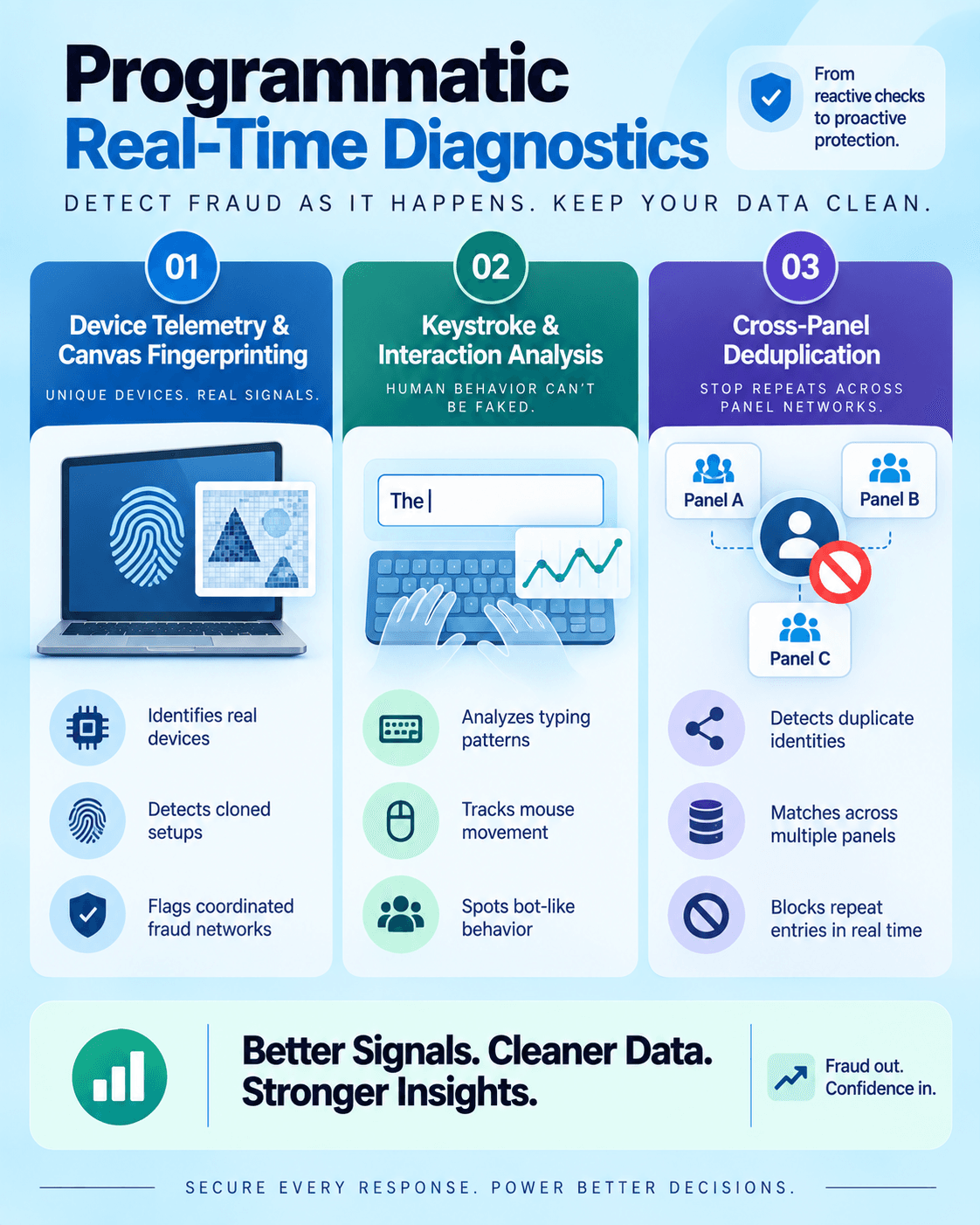
Advanced Device Telemetry and Canvas Fingerprinting
While residential proxies hide basic IP markers, they cannot fake the physical hardware architecture of the host machine. Advanced validation pipelines utilize silent, background code scripts to execute cryptographic challenges inside the user's browser. One of the most effective is canvas rendering fingerprinting. The browser is instructed to render a hidden, highly complex geometric shape with text overlays behind the scenes. Because every computer graphics card, operational system, and driver variant handles anti-aliasing and sub-pixel rendering with microscopic variances, the resulting image hash is incredibly unique.
If twenty different survey responses arrive from twenty distinct residential IPs across California, but they all produce the exact same microscopic canvas rendering hash down to the pixel, it reveals that a single server or cluster is programmatically generating those accounts. The system can automatically quarantine the entire cluster in real- time, protecting the sample funnel from coordinated attacks.
Keystroke Dynamics and Interaction Physics
Human interaction with a web page is chaotic, unpredictable, and physically bounded. When a human typing a response into an open-ended field interacts with their keyboard, the intervals between keystrokes fluctuate based on cognitive strain, muscle memory, and linguistic planning. The delay between the letters 'T' and 'H' in the word 'The' might be 40 milliseconds, while the delay between 'h' and 'e' could be 120 milliseconds. Bots, by contrast, insert text using script injections or programmatic string transfers that dump the entire text block into the document object model (DOM) instantly, registering a 0-millisecond duration across hundreds of characters.
Even when scripts try to mimic human input by adding synthetic delays, they usually generate clean, uniform distributions (like a steady 80ms break between every key press) that fail advanced statistical tests for human variance. The same principle applies to mouse tracking. Humans move their cursor in sweeping, imperfect curves that slow down as they approach a clickable button. Bot scripts often move in perfect, unvarying straight lines or teleport directly across coordinate planes instantaneously, immediately triggering behavioral alerts.
Cross-Panel Network Deduplication
A prominent structural flaw in market research is sample overlapping. Most large enterprises purchase sample sizes from multiple panel brokers simultaneously to fill quotas quickly. Professional fraud networks exploit this by registering the same fake identity across dozens of independent panels. By deploying a cross-panel identity network graph, modern platforms can track behavioral hashes across separate panel vendors. When a specific hardware profile or behavioral signature tries to complete the exact same study through Panel Vendor A, Panel Vendor B, and Panel Vendor C, the system blocks the duplicate entries globally, preventing a single entity from claiming multiple incentive payouts.
Featured Solution: SoftSight SurveyGuard
To combat these evolving vectors automatically, platforms like SoftSight SurveyGuard offer a dedicated, real-time protection suite for modern market research pipelines. Implemented directly into survey entry flows, SurveyGuard executes real-time telemetry diagnostics to neutralize fraud before respondents contaminate active datasets.
- Sub-200ms Pre-Survey Gate: Scores incoming traffic across 15 distinct structural & device detection layers in under 200ms.
- Canvas Fingerprinting & Hardware Telemetry: Identifies underlying hardware clusters hiding behind legitimate residential IP proxies.
- Interaction Physics Monitoring: Tracks keystroke dynamics and non-linear cursor movements to catch headless browsers and injection scripts.
- Generative AI & LLM Interception: Flags artificially formatted open-ended responses and automated synthetic text structures in real-time.
- Cross-Panel Global Deduplication: Tracks cross-vendor identity graphs to block duplicate attempts across separate panel suppliers.
5. The Strategic Caveat: Balancing Security and Sample Bias
As research teams build out strict data security frameworks, they must navigate a delicate, strategic balancing act. If security settings are configured too loosely, fraudulent data slips through and corrupts your insights. However, if algorithmic thresholds are tuned to an overly aggressive, hyper-restrictive extreme, you introduce a dangerous counter-risk: false-positive sample bias.
Overly aggressive algorithmic models risk systematically striking down legitimate human respondents who exhibit unusual but natural behavioral patterns. For instance, neurodivergent individuals, non-native English speakers, or older demographics might use keyboard shortcuts, rely heavily on browser translation extensions, or pause for long, irregular periods during open-ended fields. If an automated script instantly bans any user who copies-and-pastes a translated sentence or takes forty minutes to complete a ten-minute instrument, the system inadvertently strips out authentic human diversity from the target sample. The goal of modern data validation is not to create a clinical, hyper-optimized monoculture of identical response profiles, but to weed out clear programmatic fraud while leaving room for the messy, unpredictable variations inherent to real human behavior.
6. Framework for High-Integrity Research Operations
To safeguard future corporate budgets and guarantee the reliability of data streams, enterprise research operations must move away from outdated methodologies. Organizations can implement a practical, four-step structural checklist to upgrade their current survey data integrity workflows:
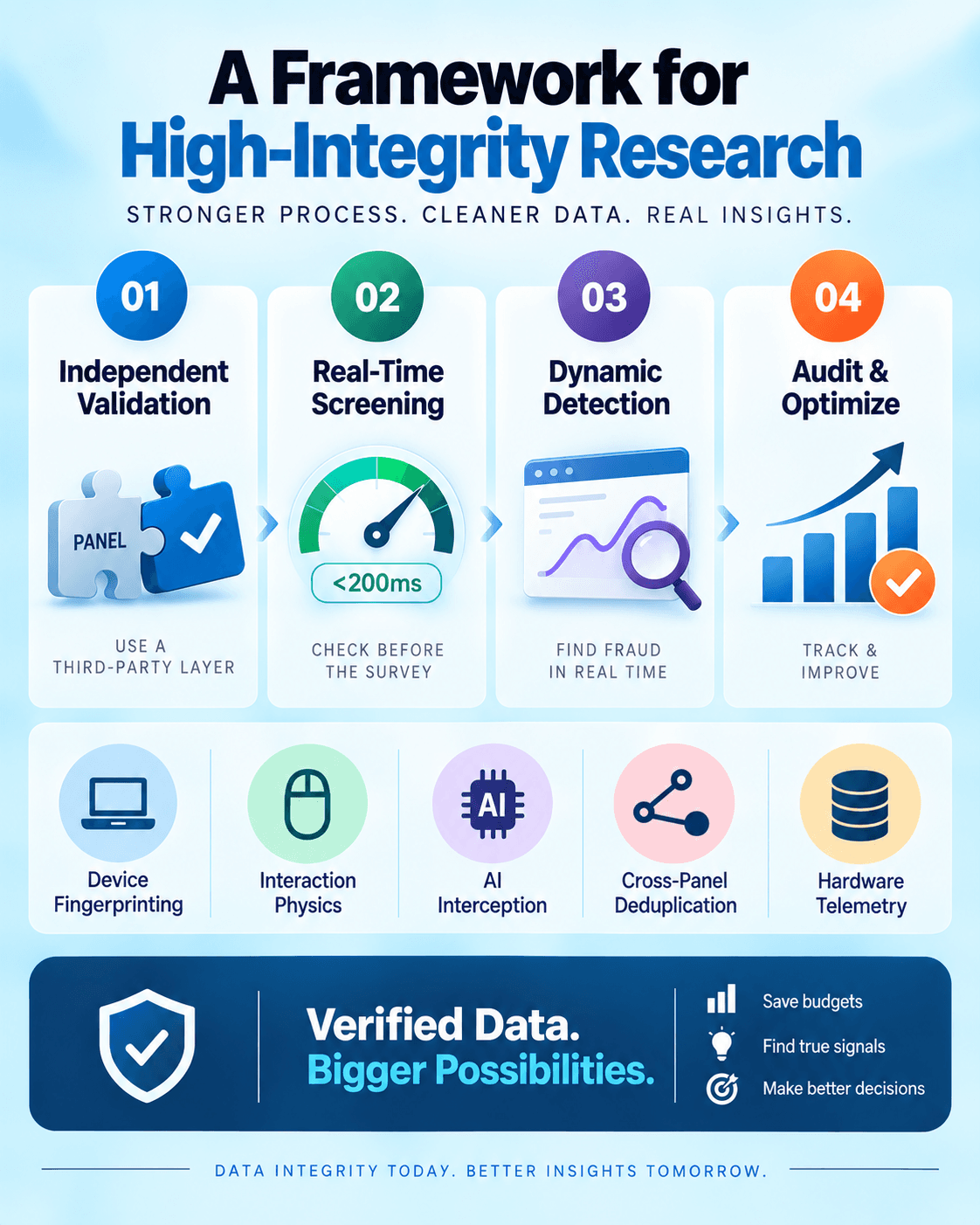
- De-couple Validation from Panel Vendors: Do not rely exclusively on internal panel suppliers to verify the authenticity of their own inventory. Always use independent, third-party verification layers built directly into the survey hosting architecture.
- Implement Live Programmatic Screening: Deploy active Javascript telemetry components at the very beginning of the survey funnel. Collect hardware, proxy, and environment signatures before the respondent answers a single demographic question.
- Replace Old Traps with Dynamic Context: Eliminate static attention checks that say 'Select option three.' Instead, use real-time contextual tracking, such as evaluating keypress delays or assessing text inputs for automated AI structures.
- Audit and Score Panel Performance: Constantly trace clean sample yields back to their original point of purchase. If a particular vendor consistently delivers data with a 45% fraud rate, reallocate your research spend to more reliable panel networks.
Ultimately, data integrity is not a one-time cleaning step at the end of a project; it is an ongoing operational commitment. By treating data quality as a continuous technical priority rather than a minor administrative task, companies can protect their budgets, find true market signals, and build strategies on verified human insights.