A market-research guide to bid escalation, replacement costs, reconciliation, and total cost of ownership
What CPI Really Means in Market Research
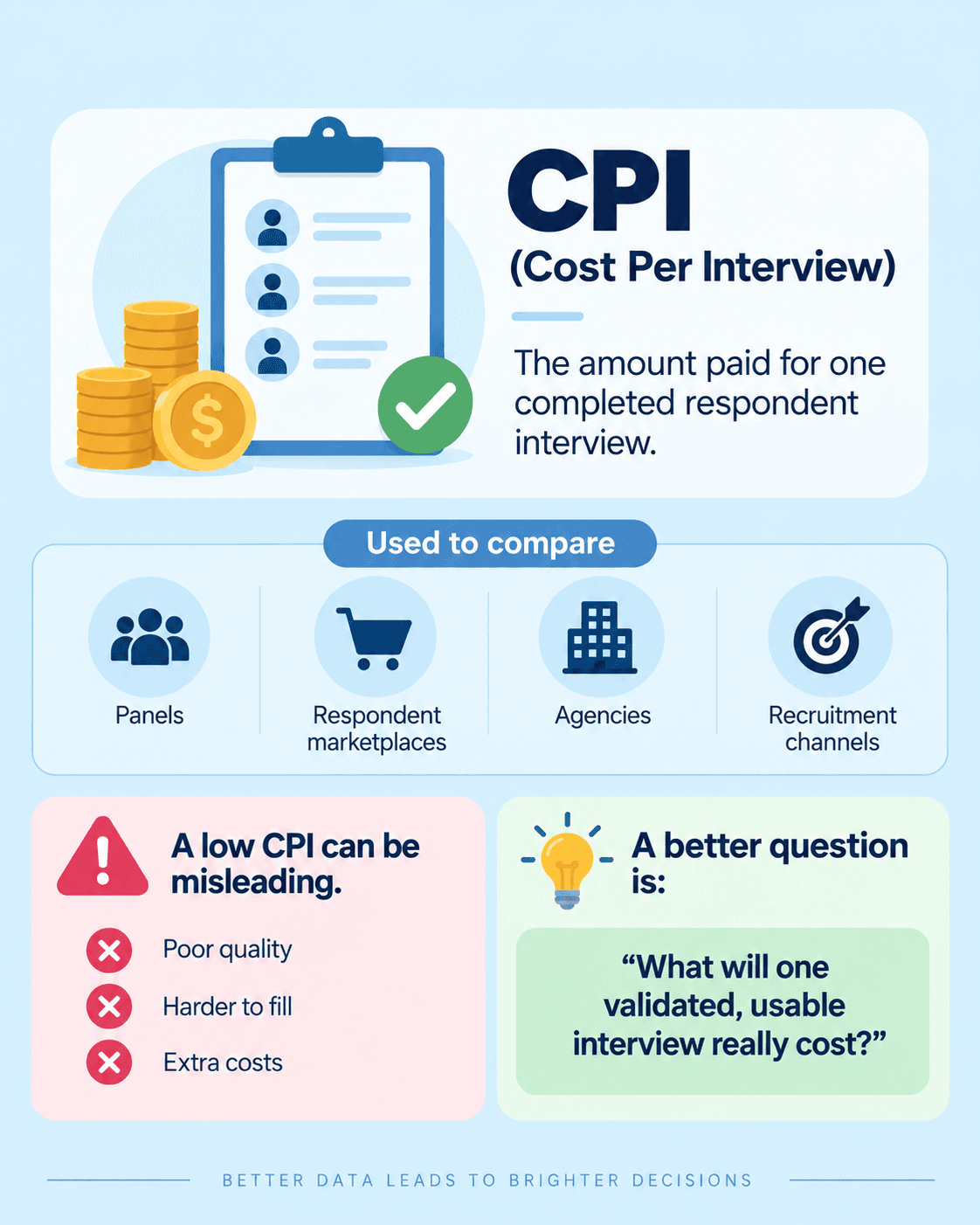
In market research, CPI means cost per interview: the amount paid for one completed respondent interview. It is commonly used to compare panels, respondent marketplaces, agencies, and recruitment channels.
But CPI is not the same as the cost of a usable interview, and it is certainly not the same as the cost of an actionable insight. A low quoted price can be misleading if the sample contains poor-quality responses, quotas are difficult to fill, invoices are difficult to reconcile, or the internal team must spend substantial time correcting problems.
The better question is not simply “What is the CPI?” It is “What will one validated, usable interview cost after all direct and indirect expenses are included?”
The $2.50 CPI Illusion
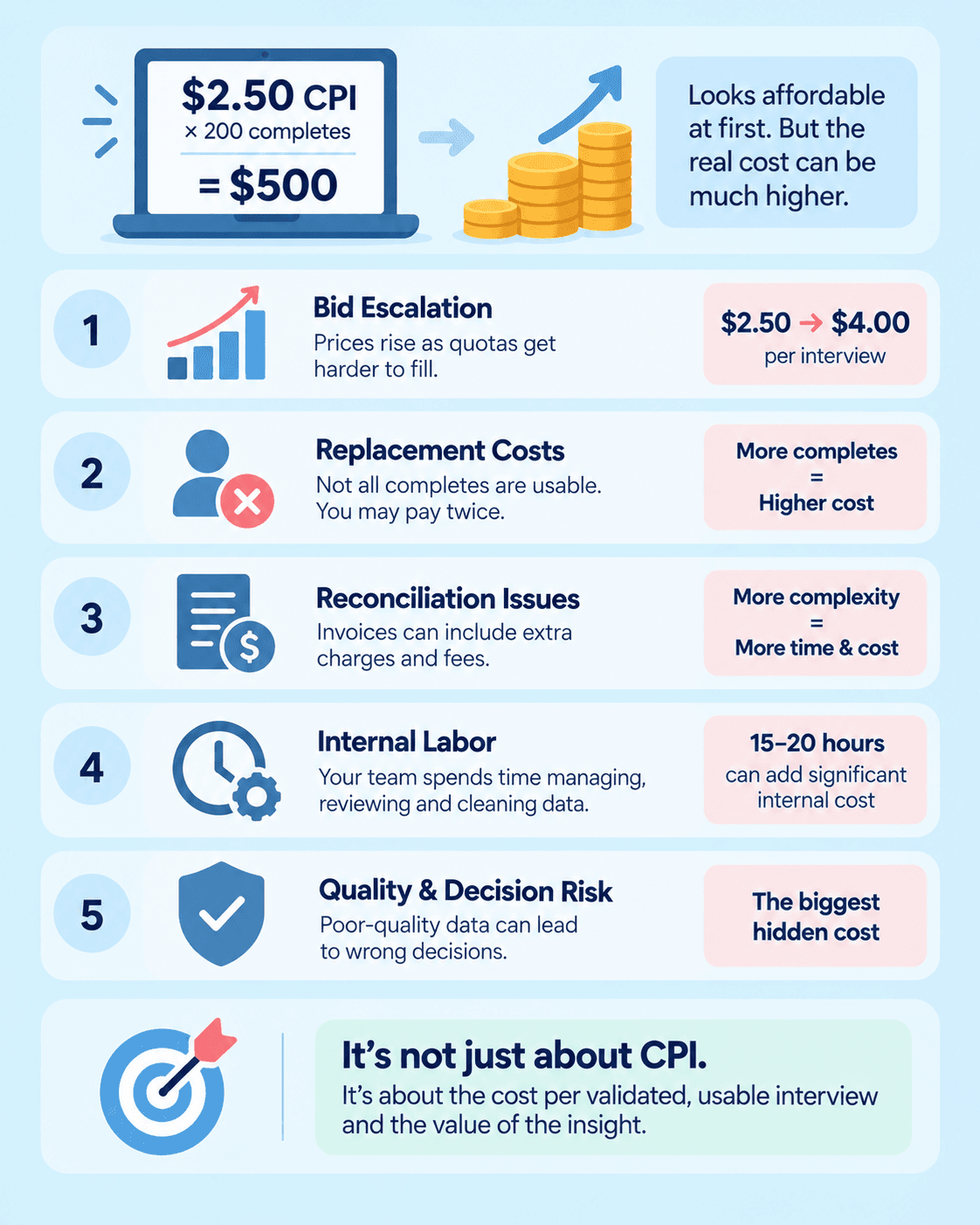
A marketplace may advertise a $2.50 CPI for general consumer interviews. At first glance, a project requiring 200 completes appears to cost only $500. That figure is attractive because it is easy to understand, easy to compare, and easy to approve.
However, the base CPI may exclude or understate the costs that appear once fieldwork begins. Demand for a particular audience can raise bids; respondents who fail quality checks may need replacement; and operational teams may spend time reviewing data, disputing charges, and preparing corrected datasets.
The headline CPI is therefore a starting price, not necessarily the final economic cost of the research program.
1. Bid Escalation: The Quiet Multiplier
On a respondent marketplace, buyers often compete for the same pool of participants. A low initial price may work only for easy-to-reach respondents, short surveys, broad targeting, or flexible timelines. As quotas become harder to fill, the effective price rises.
Escalation may occur when a study targets a narrow demographic, requires a longer survey, needs fast turnaround, applies multiple screening conditions, or competes with many other projects. Even when the rate change is technically visible, it may not be apparent during initial budgeting.
For example, a study advertised at $2.50 CPI may ultimately require an average spend of $4.00 per completed response to reach quotas. At 200 completes, the direct spend has already increased from $500 to $800 before considering quality failures or staff time.
2. Replacement Costs: Paying Twice for One Usable Interview
Not every completed interview should be used. Researchers may remove speeders, inconsistent respondents, duplicate participants, inattentive answers, fraudulent responses, or people who do not genuinely meet the screener criteria.
Each rejected record creates a replacement requirement. The organization has paid for the original response, but it still needs another response to maintain the target sample size. This is why the number of “completes purchased” and the number of “usable completes analysed” can be very different.
If a team buys 250 interviews at an effective $4.00 CPI but only 200 pass quality review, direct spend is $1,000. The apparent CPI may have been $2.50, yet the direct cost per usable interview is already $5.00.
High replacement rates also affect schedule risk. Fieldwork takes longer, reporting moves later, and business decisions may be delayed while researchers wait for valid sample.
3. Reconciliation Issues: The Back-Office Tax
Research invoices can become complicated when they include base completes, incidence adjustments, screener failures, quota surcharges, replacements, credits, cancelled sessions, and platform fees. A low per-interview rate can be offset by operational complexity.
Reconciliation is the work of matching the supplier’s charges with project records, study quotas, delivered data, rejected responses, and approved credits. When pricing is fragmented or replacement rules are unclear, research operations and finance teams may spend hours resolving discrepancies.
This cost rarely appears in a supplier’s CPI quote. Yet it is real: it consumes employee time, delays payment approval, increases vendor-management effort, and can reduce confidence in the study’s financial controls.
4. Internal Labor: The Often-Missed Cost
Internal labor is frequently the largest hidden component of research total cost of ownership. People must design the study, set up the screener, manage the supplier, monitor quotas, review sample quality, clean data, analyse results, prepare reporting, and communicate findings.
Cheap sample often requires more intervention rather than less. If quality is inconsistent, analysts may conduct additional checks. If quotas stall, project managers may revise targeting or negotiate with vendors. If the invoice is unclear, operations staff may need repeated follow-up.
For a small project, these tasks can easily add 15 to 20 hours of internal work. At a fully loaded internal rate of $50 per hour, that represents $750 to $1,000 of cost that does not appear in the marketplace CPI.
5. Quality and Decision Risk
The most significant hidden cost is the cost of making a weak decision from weak evidence. Poor-quality respondent data can produce misleading percentages, false patterns, or conclusions that stakeholders cannot trust.
This may lead to further research, delayed product decisions, unnecessary campaign changes, or a launch based on an inaccurate understanding of the audience. The financial effect can be far larger than the savings gained from selecting the lowest CPI supplier.
Therefore, research buyers should assess cost per actionable insight, not only cost per completed interview. A more expensive study can have lower total cost if it yields reliable evidence, faster decisions, and fewer repeat projects.
A Worked Example: From $2.50 to $9.25
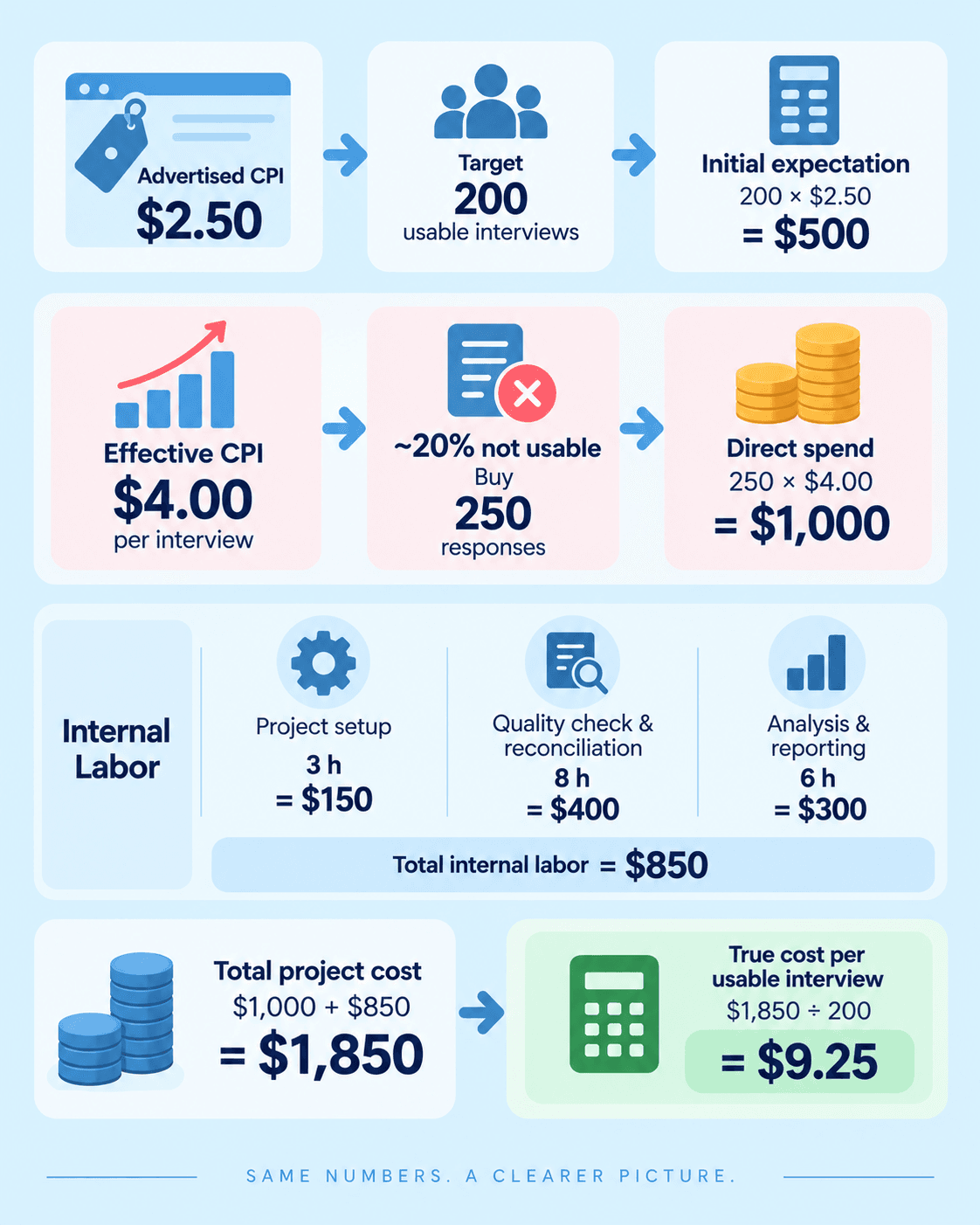
Assume a company wants 200 usable consumer survey interviews. A marketplace advertises a CPI of $2.50. The initial expectation is: 200 × $2.50 = $500.
In field, competition and quota difficulty raise the effective interview price to $4.00. The research team also finds that approximately 20 percent of records are not usable after quality review, so it purchases 250 responses to secure 200 valid ones.
Direct marketplace spend: 250 × $4.00 = $1,000.
Now add internal work: project setup and vendor management (3 hours = $150), quality checking and reconciliation (8 hours = $400), and analysis/reporting support (6 hours = $300). Total internal labor equals $850.
Fully loaded project cost: $1,000 direct spend + $850 internal labor = $1,850.
True cost per usable interview: $1,850 ÷ 200 = $9.25.
The project did not become expensive because $2.50 was mathematically wrong. It became expensive because the headline price did not represent the complete cost of acquiring 200 credible and usable interviews.
How to Calculate True CPI
Use the following calculation for every study:
True CPI = (Direct supplier spend + internal labor + rework costs + allocated platform costs) ÷ usable interviews
Direct supplier spend includes all invoices, escalation, premiums, replacements, fees, and non-refundable failed attempts. Internal labor includes the time of researchers, project managers, finance staff, data analysts, and stakeholders involved in managing the work.
Only count interviews that pass the agreed quality standard and are actually included in analysis. This prevents a project from appearing efficient simply because it purchased a large number of unusable records.
A Practical TCO Framework
Total cost of ownership (TCO) is a broader measure than CPI. It captures every meaningful cost required to obtain, use, manage, and act on research data.
TCO = Direct sample cost + platform fees + bid escalation + replacement cost + internal labor + reconciliation effort + rework + decision-risk exposure
Not every item can be calculated perfectly, especially decision-risk exposure. Still, tracking the major categories gives procurement and research teams a more honest comparison between vendors and methods.
How to Reduce True Cost
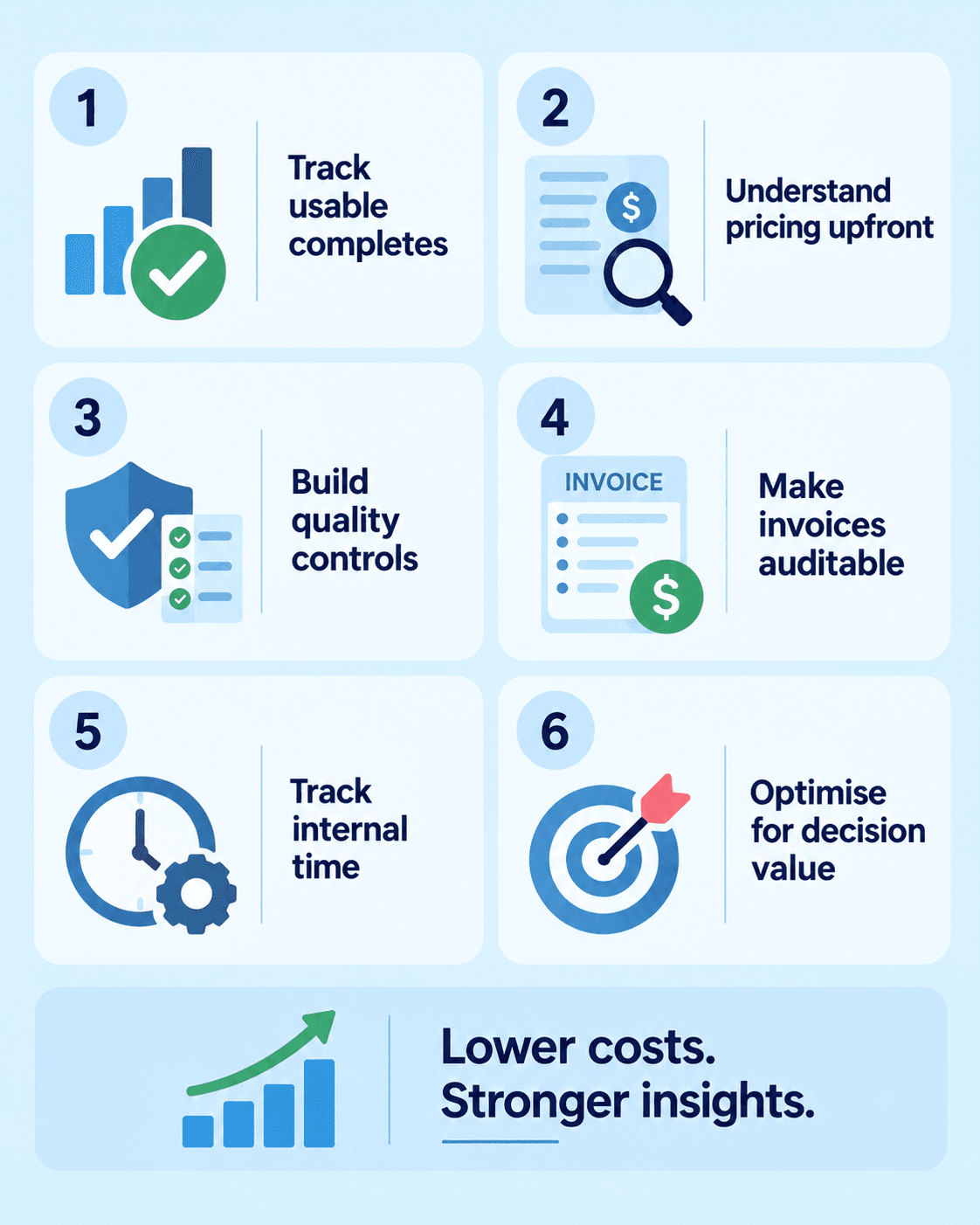
1. Measure usable completes, not purchased completes. Track rejection, replacement, and re-contact rates by vendor and audience.
2. Ask about price behaviour before launch. Request information on quota difficulty, likely bid escalation, incidence assumptions, and the supplier’s policy for replacements and credits.
3. Build quality controls into the study. Use clear screeners, attention checks, duplicate detection, open-ended response review, and realistic survey-length expectations.
4. Make invoices auditable. Require a transparent breakdown of base CPI, surcharges, replacements, credits, and fees so finance can reconcile spend efficiently.
5. Track internal time. Log the hours spent on setup, supplier management, cleaning, reconciliation, and reporting. This reveals which “cheap” channels are creating expensive work.
6. Optimise for decision value. Choose the approach that produces trustworthy, timely answers not merely the lowest initial price.
Questions to Ask a Research Vendor
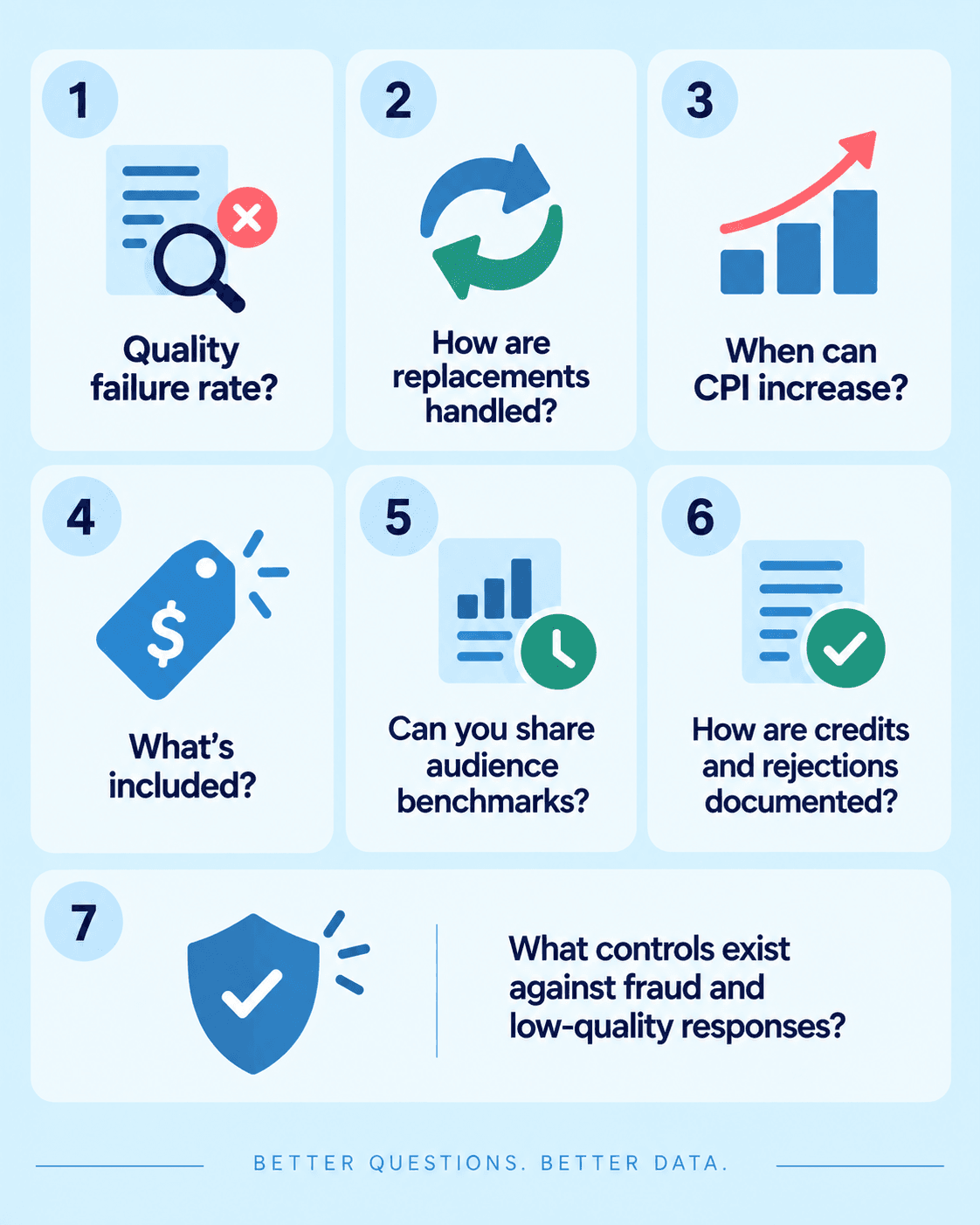
Before choosing a marketplace or panel, ask the following questions:
- • What proportion of delivered interviews typically fail quality review for studies like ours?
- • How are low-quality responses replaced, and who pays for them?
- • Under what conditions does the CPI increase during fieldwork?
- • Which charges are included in the quoted CPI, and which are billed separately?
- • Can you provide historical incidence, completion, and replacement benchmarks for this audience?
- • How will credits, rejected responses, and invoice adjustments be documented?
- • What controls are available for fraud, duplication, speeding, and inattentive responses?
Conclusion
A $2.50 CPI can be useful as a starting benchmark, but it should never be treated as the full price of research. Bid escalation raises field costs; low-quality responses create replacement costs; fragmented billing creates reconciliation work; and internal teams absorb substantial labor that is not visible on the initial quote.
The most reliable purchasing metric is the true cost per usable interview and, ultimately, the cost per confident decision. Organizations that measure TCO make better vendor choices, protect research quality, and avoid false savings created by a low headline CPI.